What a Night in a Private Sahara Camp Is Really Like
A private Sahara trip sounds straightforward until you start comparing camps and realise that “luxury desert camp” describes everything from a mattress on a rug to a suite with a hot shower. This is what the night actually involves, hour by hour, and how to tell the tiers apart before you book.
When you arrive, and why it matters
Camps are reached in the late afternoon, and that timing is deliberate rather than decorative. Arriving at four or five o’clock gives you the golden hour on the dunes, dinner at a civilised time, and enough darkness afterwards for the sky to do what you came for. Arriving after dark — which happens when a driver tries to cover Marrakech to Merzouga in a single day — costs you the entire first evening.
At Erg Chebbi the road runs to the edge of the dunes, and the last stretch to camp is either a short 4×4 transfer or a camel ride of twenty to forty minutes. At Erg Chigaga the approach is an hour and a half or more of off-road driving across stony hamada before any sand appears. In our experience that transfer is the single thing guests underestimate about Chigaga: it is genuinely rough, and it is also the reason almost nobody else is out there.
The three tiers, described honestly
Camps in Morocco fall into three broad categories, and the words used to market them overlap badly. Soufiane names the specific camp in every proposal for exactly this reason: the category tells you very little, the camp name tells you everything.
| Standard | Luxury | Exclusive-use | |
|---|---|---|---|
| Bathroom | Shared blocks, a short walk | En-suite inside the tent | En-suite inside the tent |
| Hot water | Limited or none | Yes, solar-heated | Yes |
| Bed | Mattress, often low | Proper bed and linen | Proper bed and linen |
| Heating | Blankets only | Heating or stove in winter | Heating or stove in winter |
| Power | Lighting for part of the evening | Solar power, charging points | Solar power, charging points |
| Other guests | 10–30 people | 10–20 people | Your party only |
| Suits | One night in mild weather | Most travellers, year round | Honeymoons, families, winter |
The honest summary: a standard camp is perfectly pleasant for one night in April. In January, when the temperature drops close to freezing after midnight, the difference between a heated luxury tent and a standard one is the difference between a memorable night and an endured one. We have had guests move camps mid-trip in winter for precisely this reason, and it is avoidable with one question at the booking stage.
The tent itself
A luxury tent is canvas over a timber or steel frame, usually on a raised platform, with rugs underfoot and a partitioned bathroom at the back. The bathroom has a flushing toilet, a basin and a shower fed from a solar tank. Hot water is genuinely hot in the evening and less reliable at six in the morning, which is worth knowing if you are the sort of person who showers before sunrise.
There is no air conditioning in most camps, because there is rarely enough power for it. What there is: canvas that can be opened on both sides for cross-ventilation, and in the better camps, a stove or electric heater for winter. Phone signal is patchy to non-existent at Erg Chigaga and usually workable at Erg Chebbi. Wi-fi, where it exists, is slow enough that most people stop trying by the second hour, which is not the worst outcome.
Dinner, music and the part people remember
Dinner is served between seven and eight: soup, salads, a tagine or couscous, fruit, mint tea. It is cooked on site in a kitchen tent, and dietary requirements are straightforward if the camp is told in advance rather than on arrival. Vegetarian is easy. Vegan and gluten-free are manageable with notice; they are not something to spring on a cook ninety kilometres from the nearest shop.
Afterwards there is usually drumming around a fire. This is the moment that divides travellers: at a good camp with Gnawa-rooted musicians it is genuinely absorbing; at a weaker one it is a performance that ends when the guests stop clapping. If music matters to you, say so when booking, because camps differ enormously and we know which ones take it seriously.
The sky
This is the real product. With no settlement for tens of kilometres, the Milky Way is visible to the naked eye for most of the year, and the better camps keep their lighting deliberately low so your eyes can adjust. Allow twenty minutes away from the fire before judging it.
Two practical points. The moon matters more than the season: a full moon is beautiful on the dunes and washes out everything faint, so if astrophotography is the point, plan around a new moon. And winter nights are the clearest of the year, which is the trade-off against the cold. Our month-by-month guide to visiting the Sahara sets out the temperatures in detail.
Sleeping outside, camels, and other things worth knowing
Sleeping outside. Most camps will set a bed out on the sand if you ask in advance. It works beautifully in May, September and October. From November to February it is cold after midnight and damp with dew by dawn.
Camels. Nobody has to ride one. The classic sunset trek lasts forty minutes to an hour, which is long enough to be uncomfortable if you are not used to it, and most guests are glad they did it once. Walking the same route is a perfectly good alternative and better for photographs.
Sand. It gets into everything. A soft bag closes better than a hard case, and a cotton cheche is more useful than a hat when the wind picks up in spring.
Children. Camps suit them well — dunes are the world’s largest sandpit — but the drive is the constraint, not the camp. On trips under ten days with young children we usually suggest the Agafay instead.
How a camp night fits into a route
One night in the desert is the minimum and two is better, because the second day is when the pace drops and people stop photographing everything. From Marrakech the drive is nine to ten hours and always split across two days, with a night in Skoura or the Dades Valley; from Fes it is seven to eight hours. The full routes, including the one-way traverse that avoids repeating the road, are on our private Sahara tours page.
If you are still deciding between the two dune seas, the comparison in Merzouga vs Erg Chigaga covers access, scale and solitude. And if the desert is one leg of a longer trip, our luxury Morocco tours show how it connects to the imperial cities and the coast.
An evening in the camp, hour by hour
It helps to know the shape of the evening before you arrive, because the rhythm is fixed by daylight rather than by a schedule anyone hands you.
Around 4.30pm. You reach the camp, drop bags in the tent and are given mint tea and almonds. There is usually an hour before the light starts to go, which is the window for walking up the nearest high dune. Take water; the climb is harder than it looks because the sand gives way under each step.
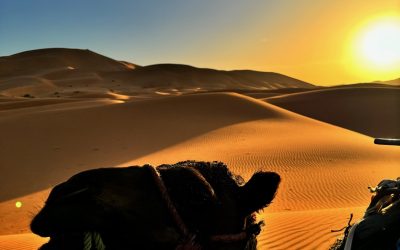
Sunset, roughly 5.30pm in winter and 8pm in midsummer. The colour change lasts about twenty minutes and moves fast at the end. This is the photograph everyone wants, and the reason we build routes to put you in camp before it, not during it.
7 to 8pm. Dinner, usually in a communal tent or outside under lights if the weather allows. In exclusive-use camps the table is yours and can be set anywhere you like, including out on the sand away from the camp itself.
After dinner. Drumming by the fire, then the sky. Most guests drift away from the fire at some point to find darkness, and the staff are used to this; ask where to walk so you stay within sight of the camp lights.
Dawn, if you can manage it. Sunrise over the dunes is quieter than sunset and, in our experience, the better of the two. It also means you are packed and moving early, which matters if the day ahead involves a long drive.
Who is actually at the camp
A camp runs on a small permanent team: a manager, two or three staff who cook and serve, and the camel handlers who live locally. Most are from the villages around Merzouga or M’Hamid, and several have worked the same camp for years. This is worth knowing for two reasons.
First, the quality of a camp is mostly the quality of those few people, which is why we book camps we have been to rather than camps that photograph well. Second, these jobs are the main source of income in desert villages with very few alternatives, and the camps worth supporting are the ones that employ locally and pay properly rather than bringing staff down from the cities for the season.
What usually disappoints people, and how to avoid it
After enough desert nights you learn that complaints cluster around four things, and all four are preventable at the planning stage.
Arriving in the dark. Caused by trying to do Marrakech to the dunes in one day. The fix is splitting the drive, which we do as standard.
Being cold. Caused by booking a standard camp in December or January. The fix is a heated tent and a jacket, and knowing that desert nights in winter are genuinely cold rather than theoretically cool.
The camp being busier than expected. Permanent camps at Erg Chebbi sit relatively close together in high season, so you may see others. If solitude is the point, that argues for Erg Chigaga or an exclusive-use camp, and we will say so plainly rather than selling you the closer option.
One night feeling rushed. You arrive late afternoon and leave after breakfast, which is roughly fifteen hours with eight of them asleep. Two nights changes the trip entirely.
What to bring for the night
Camps provide bedding, towels and water. Bring a head torch, which is more useful than a phone light when you are walking out to look at the sky; a warm layer in any month between October and April; lip balm and moisturiser, because the air is extremely dry; and a small bag for the night rather than your main case if the final approach is by camel or 4×4.
Leave behind: hard luggage you would mind scratching, heels of any kind, and expectations of a hairdryer. Sand will get into your camera bag regardless, so a simple cloth cover is worth more than a specialist case.
Combining the desert with the rest of Morocco
Very few travellers come to Morocco only for the Sahara, and the desert sits better as the midpoint of a route than as a destination in itself. From Merzouga the natural continuation is north through the Ziz Valley to Fes, or back west through the Dades and Aït Ben Haddou to Marrakech. Either way the drive is long, and either way the valleys are half the reason to do it.
If you are building a complete itinerary, our guide to private travel across Morocco explains how the regions connect and how far apart they really are, and bespoke Marrakech experiences covers the city days at either end.
Frequently asked questions
- Do luxury desert camps have private bathrooms?
- At the luxury tier, yes: a flushing toilet, basin and solar-heated shower inside your own tent. Standard camps use shared facilities a short walk away. Ask for the camp by name rather than by category, because the category is not regulated.
- How cold does the Sahara get at night?
- In January the overnight average is around 38°F (3°C) and can touch freezing on open sand. In October it is a comfortable 58°F (14°C). Winter camps should have heating or a stove, not just extra blankets.
- Is there electricity and wi-fi in the camps?
- Solar power runs lighting and charging points in most luxury camps. Wi-fi is either absent or slow, and phone signal is weak at Erg Chigaga. Plan for being offline rather than hoping otherwise.
- How many nights should we spend in the desert?
- One night is the minimum that justifies the drive; two is noticeably better. Two nights also allow a full day in the dunes without the pressure of packing up at dawn.
- Can we have the camp to ourselves?
- Yes, at exclusive-use camps, which is the most requested upgrade we handle. It makes the greatest difference at Erg Chigaga, where silence is the whole point.
Planning a night in the dunes
Tell us your dates, who is travelling and which standard you have in mind, and we will come back with a named camp, a route that reaches it in daylight, and a quotation for your party. Email soufiane@wanderlustmorocco.com or message +212 645 870 467 on WhatsApp.