Marrakech Fashion and Design: A Field Guide to the Real Thing
Ateliers · Textiles · What You Are Actually Buying
Marrakech is two things at once: a working craft economy that has made cloth and leather for centuries, and a contemporary design scene with international reach. Most visitors see a souvenir version of both. This is how to find the actual thing — and how to tell what a label is really telling you.
By Soufiane, Founder — Wanderlust Morocco
There is a shop in the medina I will not name that sells, in its window, a rail of embroidered jackets described as the work of local artisans. They are machine-embroidered imports. Forty metres away, up a lane with nothing in the window at all, a man and his two sons do hand embroidery on commission for designers whose names you would recognise.
That gap — between the version of Marrakech craft that is merchandised to visitors and the version that actually supplies the industry — is the whole subject of this article. It is not a story about being cheated. Most sellers are not lying; they are selling what sells, in the words their customers use. But if you came here interested in Marrakech fashion and design rather than in taking home a souvenir, the two are different cities, and you have to ask differently to get into the second one.
What follows is what I would tell a friend arriving with two days, a real interest, and no intention of buying a camel-leather pouf.
How Marrakech Became a Fashion City
This is not a recent invention, and it is not purely a European import either, but the European chapter is well documented and worth getting right.
The thread starts earlier than Saint Laurent, with a painter. Jacques Majorelle, a French Orientalist artist, began building a garden on the edge of Marrakech in 1923 and worked on it for the better part of forty years. The cobalt he painted it in — taken, by his own account, from the colour of local tiles and of Berber burnouses — he patented before his death, and it carries his name: Majorelle blue. He opened the garden to the public in 1947 and charged admission to help pay for its upkeep. Then it went wrong. After a divorce in the 1950s he was forced to sell the house and the land, the garden was neglected and fell into disrepair, and he died in 1962.
That is the part usually left out, and it is worth keeping, because it explains what came next. Yves Saint Laurent first came to Marrakech in the 1960s and kept returning for the rest of his life; he and Pierre Bergé bought and restored the Majorelle property in the 1980s, and held the villa until 2008. The influence ran in both directions — the colour in his work after Morocco is unmistakable, and his presence drew a generation of designers and decorators to the city.
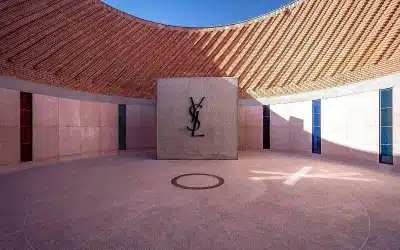
That history now has a building. The Musée Yves Saint Laurent Marrakech, designed by the Paris- and Marrakech-based practice Studio KO — Karl Fournier and Olivier Marty — opened in autumn 2017 next to the Jardin Majorelle. It runs to 3,857 square metres and draws on the Fondation Pierre Bergé – Yves Saint Laurent collection, which holds some 5,000 garments and 15,000 haute couture accessories alongside tens of thousands of sketches and objects. Only a rotating selection is on display at any time, which is the point: go for the exhibition that is on, not for a permanent greatest-hits display.
The city has also hosted international fashion at full scale. Dior staged its Cruise 2020 show at El Badi Palace in April 2019, under Maria Grazia Chiuri, with a set of collaborations worth noting because they say something about how the industry now works with African craft: wax fabric produced by Uniwax in Côte d’Ivoire, Bar jackets reinterpreted by Grace Wales Bonner and by the artist Mickalene Thomas, a shirt by Pathé’O honouring Nelson Mandela, headpieces by Stephen Jones with the milliners Martine Henry and Daniella Osemadewa, and garments made by artisans from the organisation Sumano, which supports women’s artisan production.
I include that list rather than summarising it because the specifics are the story. The show was not simply staged in Morocco as a backdrop; parts of it were made through African ateliers. That distinction — backdrop versus supply chain — is exactly the distinction a visitor should be able to make about any workshop they are taken to.
The Caftan, and What Its UNESCO Listing Actually Means
In December 2025, at the twentieth session of its Intergovernmental Committee in New Delhi, UNESCO inscribed “Moroccan Caftan: art, traditions and skills” on the Representative List of the Intangible Cultural Heritage of Humanity.
It matters more than a plaque. The caftan is not a single garment but a whole system of trades: the cutting, the sfifa and aakad braid-and-button work, the randa and maalem embroidery traditions, the brocades and the belt-makers. Each of those is a separate apprenticeship, and several of them have been thinning out as machine substitutes got cheaper. An inscription of this kind is a formal statement that the skills, not the object, are the heritage — which is the right framing, and the one that should shape how you shop.
The practical consequence for a visitor: a caftan is the single best thing to commission rather than buy off a rail. A fitted one made over several days by a maalem who does the braid work by hand is a genuine piece of this tradition. A pre-made one in a tourist shop, machine-embroidered on synthetic cloth, is a costume. Both exist, often at prices that are closer together than they should be, and the only reliable way to tell them apart is to watch the work being done or to be taken to the person doing it.
What You Are Actually Buying: Materials, Honestly
This is the section that will save you the most money and the most disappointment.
“Cactus silk” is not cactus, and it is not silk
You will be offered shimmering, slightly coarse fabric — cushions, throws, upholstery, sometimes clothing — described as sabra, agave silk or cactus silk, with a story about fibre drawn from the agave plant.
It is rayon. Independent investigators who went looking for Moroccan cactus-fibre production found none: no farms, no processing machinery, and distributors who said the material had never been produced in Morocco. Laboratory testing confirmed rayon; one packaging label read “cheap rayon” outright, and a Barcelona manufacturer supplying much of the high-end “sabra” sold in Morocco said what it actually sells is acetate filament. Attempts to extract usable textile fibre from cactus using methods from Algeria, Mexico and the Philippines failed. In most woven sabra pieces the rayon is the weft, with a cotton warp, because the rayon is too weak to be warped.
Does that make it worthless? No. Rayon-and-cotton weaving by hand on a wooden loom is real work with a real result, and some of it is beautiful. But you should pay a rayon price for a rayon textile, and you should know that the plant story is marketing. If a seller insists on the cactus origin, ask where the farm is. The honest ones laugh and tell you it is viscose.
Leather, babouches and what “handmade” covers
Marrakech leather ranges from genuinely hand-stitched work in goat and sheep to split-leather items assembled with glue and sold with the same adjective. Press the sole of a babouche and look at the stitching density; look for a lining; check whether the edges are burnished or raw. The tanneries are real and worth seeing, though be aware that an unsolicited “guide” who appears to escort you there and hands you a sprig of mint is running a commission operation, not a cultural service.
On the word handmade: in practice it covers everything from hand-cut and hand-stitched throughout, to a machine-made body with hand finishing, to hand-assembled imported parts. None of those is fraud, and the last one is still someone’s job. Just ask which it is. A workshop that does the first will show you, immediately and with some pride.
Zellige, tadelakt and the design materials
If your interest is interiors rather than clothing, the two materials to understand are zellige — hand-cut glazed terracotta tile, where the irregularity of each piece is the entire aesthetic point and the mark of hand-cutting rather than a defect — and tadelakt, the polished lime plaster used for walls and bathrooms. Both are now widely imitated with machine-made tile and acrylic coatings that look similar in a photograph and behave quite differently over time. Both are also, usefully, things you can watch being made.
The Medina by Trade, Not by Shop
The souks are organised by craft rather than by price point, which is the key to navigating them with any purpose. The names shift depending on who you ask and some quarters have drifted over the years, but the structure holds, and asking for a trade rather than a product changes what you are shown.
Where the cloth and clothing are
The kissaria — the covered market at the core of the souks — is the textile and clothing heart: bolts of fabric, braid and trim, made-up garments. This is where you buy material for a commission, and where you can compare what a metre of real brocade costs against what the finished tourist garment is priced at, which is an education in itself.
Nearby, the tailors and embroiderers work largely out of sight, in upper rooms and side lanes, because they work to order rather than to passing trade. You generally do not find them; you are taken to them. This is the single clearest case where a guide who knows the trades is worth more than one who knows the shops.
The dyers’ lanes
Souk Sebbaghine, the dyers’ souk, is the photogenic one — skeins of wool and silk hung overhead to dry in blocks of colour. It is also where you should ask the most pointed question of your visit: are these dyes natural or synthetic?
Most commercial dyeing in the medina today uses synthetic dyes, which are cheaper, faster and far more colour-fast. That is not a scandal; it is the global textile industry. But natural dyeing — indigo, madder, pomegranate rind, henna, walnut husk — still exists, costs considerably more, and produces colours that behave differently in the light. Meanwhile “saffron-dyed” yellow is very often safflower or a synthetic, because real saffron at dyeing quantities would cost more than the cloth. Ask which it is and you will usually get a straight answer; the question signals that the answer matters to you.
Leather, metal and wood
Souk Cherratine is the leather and saddlery quarter, Souk Haddadine the ironworkers — you hear it before you see it — and Souk Chouari the woodworkers and basket-makers. For design-led shopping these are where the most interesting unglazed, un-touristed work tends to be, partly because the objects are less portable and so less merchandised.
Sidi Ghanem: The Design District Nobody Puts on an Itinerary
Sidi Ghanem is Marrakech’s industrial zone, about fifteen minutes out of the centre, and over the last two decades it has become the city’s design quarter. Ceramics studios, textile workshops, furniture makers, lighting designers, concept stores and a number of the ateliers that supply hotels and export markets all operate out of unglamorous warehouse units along numbered streets.
It is the opposite of the medina experience, and that is why it is worth a morning. There is no haggling theatre, prices are generally fixed and marked, and you are dealing with the people who actually make the thing. The downside is that it is genuinely an industrial estate: it is not pretty, signage is poor, many units keep shop hours rather than tourist hours, and several of the best are closed on Sundays or by appointment only. Going without a plan is how people waste a morning there.
It also pairs badly with the medina on the same day — not because of distance but because of register. Give it its own slot.
Museums and Galleries, and Which Are Worth the Time
Beyond the Yves Saint Laurent museum, two institutions are directly relevant if design is your reason for coming.
MACAAL — the Museum of African Contemporary Art Al Maaden — was founded in 2018 by Othman Lazraq and his father Alami as Marrakech’s first contemporary art museum, built around a collection of some 2,500 works. It reopened in February 2025 after a substantial renovation with the exhibition “Seven Contours, One Collection,” showing over 150 rotating works. It sits outside the centre, near Al Maaden, which means a deliberate trip rather than a drop-in.
Dar El Bacha, the former pasha’s residence on the edge of the medina, now houses a museum of cultural confluences and is worth visiting as much for the building and its tilework as for what is hung in it — it is one of the clearest places in the city to read zellige and carved plaster at close range.
What I would skip, or at least deprioritise: the small privately run “museums” that are substantially shops with an entrance fee. They are not scams, but they are retail, and you should know which you are walking into.
How to Visit an Atelier Properly
The single structural thing to understand about workshop visits in Marrakech is commission. A great many guides and drivers are paid a percentage by the shops and workshops they bring clients to. This is normal, legal and openly practised, and it has two consequences: you will be taken where the commission is rather than where the best work is, and the visit cannot comfortably end without a purchase.
Ask the question directly, of whoever is arranging your day: do you take commission from the places we visit? The answer determines whether you are on a tour or a shopping route. We pay our own guides and they take nothing from the workshops, which is precisely why an atelier visit on one of our days can end with a conversation and no transaction, and nobody is uncomfortable.
Once you are in the right place, the questions that open things up are specific rather than general:
- Who did this piece — is the maker here, and may I watch?
- Which parts are done by hand, and which by machine?
- What is the fibre or the hide, exactly?
- How long does one take?
- Do you work on commission, and what is the lead time?
“How much?” asked first sets up a negotiation. The questions above set up a conversation, and in my experience they also get you a better price, because they signal that you can tell the difference.
Getting It Home
This is the unromantic part that decides whether a purchase becomes a pleasure or a problem, and it is worth thinking about before you buy rather than after.
- Textiles travel well; ceramics and zellige do not. Cloth compresses, weighs little and survives a suitcase. Hand-cut tile and glazed pottery are heavy, brittle at the edges, and the most common thing travellers break. If you want tile, buy it from somewhere that crates and ships properly, and accept that the shipping is a real fraction of the cost.
- Shipping is usually worth it above a certain size. Established workshops and the better Sidi Ghanem studios ship routinely and will give you a tracked, documented consignment. Get the paperwork, the declared value and the insurance in writing before you pay. A vague promise to “send it” from a market stall is a different proposition.
- Check your own import rules, not Morocco’s. Most textiles, leather goods and ceramics are unremarkable at customs. The categories that can cause trouble are animal products — certain skins, hides and anything that could involve a protected species — and antiques. If something is described to you as old, ask how old and whether it needs documentation.
- Keep the receipt and the description. Not for customs so much as for insurance, and for your own memory of what the fibre actually was.
- Commissioned pieces need a plan. Decide at the point of order whether you are collecting in person or having it shipped, and if collecting, build a day of slack before your flight. A caftan that is ready the afternoon you leave is a caftan you will be anxious about.
A Two-Day Shape That Works
Day one, the medina. Start early in the souks with a guide who knows the trades rather than the shops — the dyers’ lanes, the babouche-makers, the tailors’ quarter. Dar El Bacha late morning for the architecture. Afternoon with one tailor or embroiderer, properly, rather than six shops briefly. If you intend to commission a caftan, this is the day to be measured, because the lead time is the constraint on everything else.
Day two, the design city. Jardin Majorelle and the Yves Saint Laurent museum first thing, before the crowds and the heat. Then Sidi Ghanem for the afternoon, planned in advance around which studios are open. MACAAL instead of Sidi Ghanem if contemporary art interests you more than product design — trying to do both in one afternoon means doing neither.
If you want to pair this with the rest of the city, our guide to private day trips from Marrakech covers what else fits around it, and the Marrakech bespoke experiences page shows how we build these days. Carpets deserve their own treatment and their own article — they are a different market with different rules, and we have set them out in our practical guide to buying a Moroccan rug.
Frequently Asked Questions
Is “cactus silk” from Marrakech real?
The fabric is real; the story is not. Testing has repeatedly identified so-called sabra or cactus silk as rayon, typically woven as weft on a cotton warp, and no cactus-fibre production has been found in Morocco. Buy it because you like the cloth, not because of the plant.
Should I buy a caftan ready-made or have one made?
Have one made if you have the days for it. The hand braid-and-button work and the embroidery traditions are what UNESCO recognised in December 2025, and they are what distinguishes a caftan from a costume. Allow several days and be measured at the start of your stay, not the end.
Is Sidi Ghanem worth visiting?
Yes, if design is a real interest and you plan it. It is a working industrial estate with fixed prices and the actual makers, not a picturesque quarter. Check opening hours first; many studios are appointment-only and several close on Sundays.
How do I avoid commission-driven shopping stops?
Ask your guide or driver outright whether they take a percentage from the places they bring you. If they do, expect to be routed accordingly. Arrangements where the guide is paid only by you are the ones where a workshop visit can end without a purchase.
How many days do I need for Marrakech fashion and design?
Two full days covers the medina trades and the design city without rushing either. One day forces a choice between them. If you are commissioning anything, build the lead time in rather than hoping to collect it the day you fly.
Planning a Design-Led Stay
The reason this subject rewards planning more than most is that almost none of it is walk-in. The good ateliers are not on the main lanes, Sidi Ghanem runs on business hours, a commissioned garment needs a schedule, and the difference between a workshop that supplies the industry and one that supplies the souvenir trade is invisible from the street.
If you would like a version of Marrakech built around this — the makers rather than the showrooms, no commission in the arrangement, and the lead times worked out so a commission actually arrives before you do — tell us your dates and what you are interested in making or finding. If you are also choosing where to stay, our guide to luxury riads and palaces in Morocco covers the houses where this kind of craftsmanship is the architecture rather than the shopping.