
Luxury Morocco Holidays
Where you sleep decides how a Moroccan holiday feels. A guide to the riads, palace hotels, kasbahs and desert camps worth building a trip around, and how to combine them.
- Soufiane
- 23/09/2026
- Wanderlust Morocco
- 4.9/5 493
Morocco has one of the most interesting luxury hotel landscapes anywhere: restored palaces inside the medina walls, mountain kasbahs on terraced hillsides, and desert camps that are genuinely remote without being uncomfortable. The difficulty is knowing which to choose, and in what order.
We plan and run the whole holiday from here in Marrakech: the properties, the private vehicle and driver-guide between them, and the licensed guides in each city. This page is about the stays themselves. If you want the itineraries first, our luxury tours page lists them.
Tell us your dates, who is travelling and the standard you have in mind. We'll propose properties and a route, with a personalized quotation, within one business day.
What Luxury Actually Means in Morocco
Star ratings travel badly. A Moroccan five-star can mean an international chain on a boulevard or a twelve-room palace where the staff know your name by the second morning. They are not the same holiday, and the price difference is often small.
What tends to matter here, in our experience:
- Scale over stars. The best riads have ten to twenty rooms. Service is personal because it has to be, not because a brand standard requires it.
- Position inside the medina. A riad five minutes from the main square and one forty minutes outside it are different trips, whatever the photographs suggest.
- The courtyard, not the lobby. Moroccan architecture turns inward. The quality of a property is usually in its courtyard, its roof terrace and its light.
- Who runs it. Owner-run riads are consistently better than managed ones, and we know which is which.

- Named before you book. Every property in your proposal is named, with its own link. You are never booking an unspecified “4-star riad” and finding out on arrival.
Five-star abroad versus five-star here
| International chain | Moroccan riad or palace | |
|---|---|---|
| Rooms | 100–300 | Often under 25 |
| Setting | New districts | Inside the old city |
| Service | Consistent, formal | Personal, attentive |
| Food | International menus | Cooked in-house, daily |
| Vehicle access | To the door | Nearest gate, then walk |
Neither is better in the abstract. Most of the holidays we plan use both: a riad for the medina nights, something larger with a pool for the end of the trip.

Riads, Palaces and City Stays
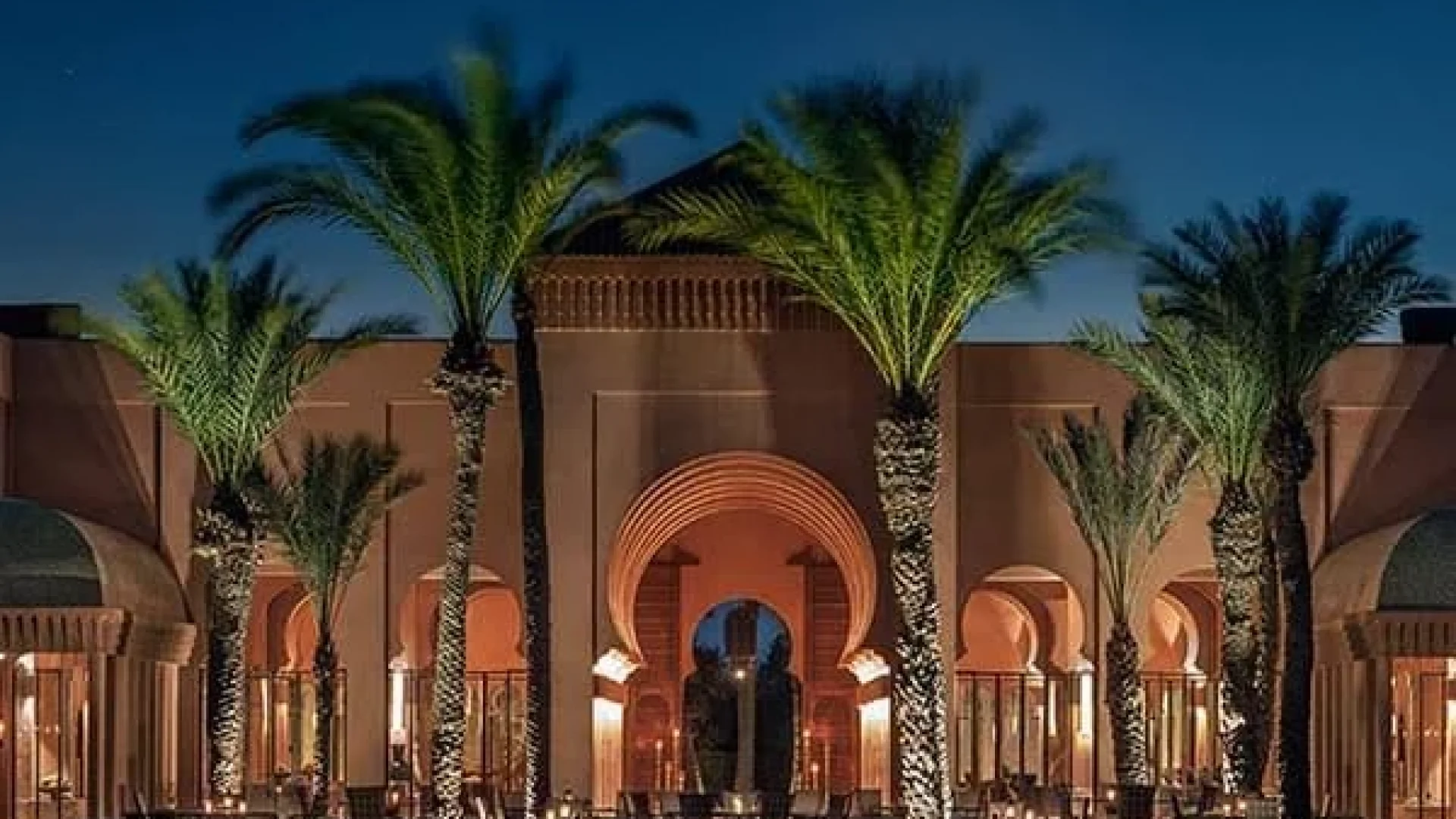
A riad is a house built around an interior courtyard, usually with a fountain and a tree, and the grander ones are effectively small palaces. In Marrakech and Fes the restored examples are the most characterful places to stay in the country: carved cedar, zellige, plunge pools in the courtyard, and a roof terrace looking over the rooftops to the Atlas or the hills.
At the top of the market sit the properties people name: the Royal Mansour and La Mamounia in Marrakech, Amanjena and The Oberoi out among the olive groves, and Palais Faraj or Riad Fès above the Fes medina. We book across all of them and have no exclusive tie to any, which means the recommendation follows your trip rather than a contract.
Below that tier, and often more enjoyable, are the owner-run riads of fifteen rooms or fewer: the same architecture, the same quality of food, and considerably more attention. These are where we place most travelers for the medina nights.
Choose a riad if: you want to be inside the old city, you value character over facilities, and you do not mind walking the last few minutes to your door.
Kasbahs, Mountain Lodges and Oases
South of the Atlas the architecture changes to rammed earth and the hotels follow: kasbah properties built in the old style with thick walls, courtyards, palm gardens and pools. The best sit in Skoura, the Dades Valley and around Aït Ben Haddou.
In the High Atlas themselves, mountain lodges look across to Toubkal from terraces at around 1,800 metres. Kasbah Tamadot above Asni is the best known; several smaller lodges in the same valleys offer the same views with fewer guests and a gentler bill.
These are the stays that make a long drive worth doing slowly. A night in Skoura breaks the road to the desert and is frequently the property people remember most.
Choose a kasbah or lodge if: you want gardens, pools and silence between the cities, or you are heading to the desert and would rather not do it in one day.
Desert Camps: What Luxury Means Under Canvas
This is where the word "luxury" is stretched furthest, so it is worth being specific.
What a luxury camp actually has. A proper bed rather than a mattress on a rug, an en-suite bathroom inside your tent with a flushing toilet and hot running water, solar power, and heating for the winter months, when desert nights fall close to freezing. Carpets, a writing table, somewhere to hang clothes.
What a standard camp has. A bed, shared washing facilities a short walk away, lighting for part of the evening. Perfectly pleasant for one night in spring; not what most people mean by a luxury holiday.
Exclusive-use camps. Beyond the tiers, some camps can be taken privately for your group alone. In the deep Sahara this is the difference between dinner in company and dinner in silence, and it is the single upgrade we are asked about most.
How we choose. We name the specific camp in your proposal, not a category. Standards vary enough between camps in the same bracket that the name is the only thing that tells you anything.
More on the properties themselves in our guide to luxury riads and palaces in Morocco.
Holiday Lengths and Routes
How long you have decides how many properties you can enjoy rather than merely pass through. Our rule: never more than one hotel change every two nights.
Seven to eight days
Enough for one half of the country at a comfortable pace: three nights in Marrakech, two in the Atlas or the Agafay, two somewhere coastal or southern. Adding the deep Sahara to a week means two long driving days for a single desert night, which rarely feels like a luxury holiday afterwards.
- 8-Day Coastal Luxury Tour. The Atlantic run through Casablanca, El Jadida, Essaouira and Agadir, with no mountain crossing. See the itinerary.
- 7-Day Culinary Tour. Markets, private cooking sessions and the table as the centre of the trip. See the itinerary.

- Imperial Cities and Sahara Discovery. Ten days through Fes, Marrakech and the dunes at Merzouga. See the itinerary.
- 10-Day Authentic Tour. Casablanca and the Hassan II Mosque through to the workshops of Fes. See the itinerary.
Honeymoons and longer stays
- Luxury Honeymoon Tour. Romantic riads, a carriage ride through Marrakech and couples’ spa time in the Atlas. See the itinerary.
- Twelve days and over. The point at which the north opens up: Tangier, Chefchaouen and Fes before the desert, finishing in Marrakech without repeating a road.
What each length realistically buys
| Days | Properties | Covers | Deep Sahara? |
|---|---|---|---|
| 5–6 | 1–2 | Marrakech and one escape | Agafay instead |
| 7–8 | 2–3 | City, mountains, coast | Not comfortably |
| 10 | 4–5 | Imperial cities and dunes | Yes, two nights |
| 12–14 | 5–6 | North to south, one way | Yes, unhurried |
We quote each holiday individually rather than publishing a figure, because the same route changes price substantially with the properties you choose, the season and the size of your party. Accommodation is nearly always the largest line.
Custom holidays
Most of what we plan does not match a published route. Tell us your dates, who is travelling, which airports suit you and the standard you want, and we draft it from scratch. Start with our holiday customisation page. We will tell you honestly if what you want needs more days than you have, and what to drop rather than rush.
The Desert Sanctuaries: Agafay or the Sahara
Every luxury holiday here eventually comes down to one question: which desert. The honest answer depends almost entirely on how many days you have, and the two experiences are not interchangeable. Both are genuinely worth doing; they simply ask for different amounts of your holiday.

The Agafay. A stone desert of pale hills about forty-five minutes from Marrakech, with the Atlas on the horizon. No dunes, but genuine emptiness, and the camps here are among the most comfortable in the country. It works as a single night, or even an afternoon and dinner, which is why it suits shorter holidays so well.
Erg Chebbi. The dune sea most people picture, rising to around 150 metres near Merzouga, nine to ten hours from Marrakech and always split across two days. The scale is the point: you walk up a dune at sunset and there is nothing manmade in any direction.
Erg Chigaga. Wilder and less visited, beyond M’Hamid and reached by an hour and a half of off-road driving. Fewer camps, almost no other visitors, and the strongest case for an exclusive-use camp.
Choosing. If Marrakech anchors your holiday, take the Agafay and spend the saved days on the properties. If the Sahara is the reason you are coming, give it ten days and do it properly.
Dining, Spa and the Rhythm of a Day

Luxury holidays here are paced around heat and light rather than opening hours, and the better properties are built for exactly that rhythm. Plan against that rhythm and the heat stops being a problem worth thinking about.
| Time | In the cities | In the desert or mountains |
|---|---|---|
| Early morning | Medina, monuments, gardens | Walking, light, cooler air |
| Midday | Courtyard lunch, pool | Shade and a long lunch |
| Afternoon | Hammam, spa, rest | Reading, tea, nothing |
| Evening | Rooftop, private table | Sunset, dinner, the sky |
Eating well. The best Moroccan food is cooked in houses rather than restaurants, which is why riad dinners matter so much. We book the private tables worth booking and arrange chef-cooked dinners in your own courtyard where the property allows it.
The hammam. Steam, black soap, a vigorous scrub with a kessa glove, then argan oil. Every good riad and palace hotel has one, and an afternoon slot is the right way to spend the hottest part of a day. Our spa and hammam page covers the ritual in detail.
Doing nothing. The most common feedback we get on holidays that worked is that there was time in them. We deliberately leave afternoons empty, and the properties we choose are ones worth staying in.
Moments Worth Planning Around
The parts of a Moroccan holiday that people describe afterwards are rarely the monuments. They are these.
Breakfast on a riad roof. Msemen, amlou, fresh juice and coffee, with the medina waking up below and the Atlas visible on a clear morning. Simple, and consistently the thing people miss afterwards.
The courtyard at nine in the evening. Lanterns lit, the fountain running, the day’s heat gone out of the tiles. This is what the architecture was designed for.
A private table in the Agafay. Linen, candles, the Atlas going pink, and no other table in sight. Forty-five minutes from the city.
The walk up a dune at sunset. Harder than it looks and worth every step. Twenty minutes of colour, then the temperature drops noticeably.
The sky at Erg Chigaga. With no settlement for tens of kilometres, the Milky Way is visible to the naked eye for most of the year. Camps keep the lights low for exactly this reason.
A hammam after a walking day. Properly done, in your own riad, it resets the trip.
An hour in a workshop. Watching a mâalem cut zellige or beat brass, with time to ask questions rather than pass through.
The Atlas from a lodge terrace. Snow on the peaks until May, orchards below, and nothing to do until dinner.
Essaouira at the end. Atlantic wind, grilled fish at the port and ramparts to walk after two weeks of dry heat inland.

Celebrations. Anniversaries, proposals and significant birthdays: a table set in the dunes, a riad taken privately for an evening, musicians arranged quietly. Tell us early and it stays a surprise.
Photography. If images matter, we plan around light rather than opening times: dawn in the dunes, late afternoon at Aït Ben Haddou, and the blue hour on a rooftop.
Wellness. Several properties run proper spa programmes rather than a single treatment room, and in the Atlas there are lodges built around walking and quiet.
Private hire. Smaller riads can often be taken over entirely for a family or a group. It needs more notice than anything else we arrange.
Flying from the US and Arrival Planning
Most American travelers lose a day at each end of a Morocco holiday without planning for it. A little thought about which airport you use changes the shape of the whole trip.

| Casablanca (CMN) | Marrakech (RAK) | |
|---|---|---|
| From the US | Nonstop service available | Via Europe or Casablanca |
| Suits | The imperial north first | Marrakech, Atlas, Agafay |
| To Marrakech | About 3 hours by road | 20 minutes |
| To Fes | About 3 hours | Long day |
| Best use | One-way routes | Return trips |
Arrival day. Morocco runs five to six hours ahead of the US East Coast depending on the season, so most people land tired. We plan nothing demanding for the first afternoon: a riad, a courtyard, a hammam if you want one, and dinner where you are staying.
One-way routing. Flying into Casablanca and out of Marrakech, or the reverse, avoids several hundred kilometres of repeated road. It is usually the single best decision in the whole plan.
Deciding on the desert first? See Merzouga vs Erg Chigaga.
Luxury Holidays for Different Travelers
Couples. The format Morocco suits best: small riads, private tables, and a pace that leaves afternoons open. Most couples want two bases rather than five.
Honeymooners. We place the memorable nights deliberately, usually a desert camp or a palace suite, and arrange whatever you want kept quiet. See our Morocco honeymoon experiences.
Families. Pools matter more than monuments. We favour properties with space and water, keep driving legs short, and use the Agafay rather than the deep Sahara on trips under ten days.
Multi-generational groups. A private holiday is the only format that paces for grandparents and grandchildren at once. Riad private hire often works better than several hotel rooms.
Mature travelers. Fewer hotel changes, ground-floor rooms where they exist, shorter driving days. Riads have stairs and rarely lifts, which is worth saying plainly, and we choose accordingly.
Celebration groups. Significant birthdays and anniversaries, where a property taken privately for two nights makes more sense than a larger hotel.
Returning visitors. If you have done Marrakech and the dunes, the second holiday is the north, the coast, or one region at a far slower pace.
First-time visitors. Almost everyone plans too much. We would rather you saw four places properly than eight from a car window.
Solo travelers. Riads suit solo travel unusually well: small, sociable at breakfast if you want it, entirely private otherwise. A private vehicle costs the same whether there is one of you or three.
By market. We write separately for American, British and Canadian travelers.
When to Go
| Season | Cities | Desert | Notes |
|---|---|---|---|
| March–May | Warm, clear | Excellent | Peak; the best properties book months out |
| June–August | 40°C+ inland | Early mornings only | Coast and mountains instead |
| September–November | Warm, settling | Excellent | Arguably the best window |
| December–February | Mild days, cold nights | Cold after dark | Heated camps; snow in the Atlas |
Spring and autumn fill first, and so do the better riad kitchens and the specialist guides.
A single day can often be arranged at a few weeks’ notice; a particular guide, a private riad hire or a high-season week needs months. More in our guide to the best time to visit Morocco for luxury travel.

Frequently Asked Questions Luxury Morocco holidays
- What makes a Morocco holiday genuinely luxury?
- Privacy, pace and the standard of where you sleep. Your own vehicle and driver-guide between properties, licensed guides in the cities, and stays chosen individually rather than allocated by category.
- How much does a luxury Morocco holiday cost?
- We quote individually, because the same route varies widely with the properties, the season and the party size. Accommodation is the largest variable by some distance.
- How many days do we need?
- Seven to eight for one half of the country, ten to combine the imperial cities with the Sahara, twelve or more to travel one-way from the north without backtracking.
- Agafay or the Sahara?
- Agafay if Marrakech anchors your trip and you have under ten days: it is forty-five minutes away. The Sahara if the dunes are the reason you are coming, which needs three days minimum.
- What are the desert camps really like?
- At the luxury tier: a real bed, an en-suite bathroom with hot water inside the tent, solar power and heating in winter. We name the specific camp in your proposal rather than a category.
- Can a riad be taken privately?
- Yes, and for families or celebrations it often works better than several rooms in a larger hotel. It needs more notice than anything else we arrange.
- Are the properties suitable for limited mobility?
- Some are, many are not. Riads have stairs and rarely lifts, and vehicles cannot enter most of the medina. Tell us when you enquire and we will choose properties that work rather than apologise later.
- Can you handle dietary requirements?
- Yes, with notice. Vegetarian is straightforward. Vegan, gluten-free and serious allergies are manageable when riads, camps and restaurants are briefed in advance.
- Do you book our flights?
- No. We plan everything from arrival to departure, and we will tell you which airports make your route work before you book them.
- Is it better to fly into Casablanca or Marrakech?
- Casablanca for one-way routes and the imperial north, including the nonstop service from the US. Marrakech for return trips centred on the city, the Atlas and the Agafay.
- How far ahead should we book?
- Six to nine months for spring, autumn and the holiday weeks. The best riads and camps are small, and they set the dates for everything else.
- Can we combine hotels and desert camps in one trip?
- That is the usual shape: riads for the city nights, a kasbah or lodge to break the drive, and one or two nights under canvas. Most holidays use three or four kinds of property.
Plan Your Luxury Morocco Holiday
Tell us four things and we will do the rest:
- Your dates, or the month you have in mind
- How many are travelling, and any children’s ages
- Which airports you can fly into and out of
- The standard you have in mind, and anything you are celebrating
We will send a proposed route with every property named and a personalized quotation for your party. If it is not right, tell us and we will redraw it. There is no cost and no obligation at this stage.
Looking for the routes rather than the stays? See our luxury Morocco tours and private Sahara tours.
Soufiane
founder of Wanderlust Morocco
I’m Soufiane, founder of Wanderlust Morocco and your dedicated designer of bespoke luxury journeys through my homeland.
Having traveled extensively from New Zealand and Australia to Canada, Japan, Europe and beyond I’ve experienced many forms of hospitality, comfort, and cultural richness. These global journeys didn’t teach me what Morocco lacks they deepened my appreciation for the beauty, luxury, and soul that already thrive here.
With Wanderlust Morocco, my mission is to reveal Morocco’s true elegance through intimate, personalized experiences that highlight its refined traditions, world-class accommodations, and unforgettable landscapes. I don’t bring luxury to Morocco; I bring you to the luxury that has always been here just waiting to be experienced the right way.
Each journey is crafted with heart, care, and the highest level of detail. Rooted in love for my country and shaped by a global perspective, every itinerary is designed to feel meaningful, seamless, and uniquely yours.