Merzouga Travel Guide: Everything to Know Before Visiting the Sahara
Merzouga is a small village at the foot of Morocco’s most famous dunes. Getting there takes planning; once you arrive, there is far more to do than the camel ride.

- Soufiane
- 11/11/2026
- Wanderlust Morocco
- 4.9/5 493
For many travellers, Merzouga simply means the Sahara. In fact it is a modest village of low earth-coloured houses in the far southeast of Morocco, sitting on the western edge of Erg Chebbi, the sand sea of orange dunes that most photographs of the Moroccan desert show.
It is not a place you can improvise. The drive is long, the season matters, and the choice between a camp in the dunes and a hotel at their edge shapes the whole stay. This guide covers how to get there, where to sleep, what to do beyond the dunes and the practical details worth knowing before you arrive.
Tell us your dates and where you are starting from. We will send back a route to Merzouga with honest drive times and the right place to stay for your season.
Merzouga at a Glance
The essentials, before the detail.
- Where it is. In the Drâa-Tafilalet region of southeastern Morocco, on the western edge of the Erg Chebbi dunes and about 50 kilometres from the Algerian border.
- The main attraction. Erg Chebbi, about 28 kilometres of dunes from north to south, with ridges rising to around 150 metres.
- Nearest towns. Rissani, about 40 kilometres north, and Erfoud beyond it, both on the paved road to Merzouga.
- Nearest airport. Errachidia, about two hours by road, with flights from Casablanca and from Marrakech.
- How long to stay. Two nights is ideal: one in the dunes, and one in a hotel at their edge.
- Best months. October to November and March to April.

- Arrive by mid-afternoon. Sunset is the reason for the day, and a late arrival is the most common way to miss it.
How to Get to Merzouga
| From Marrakech | From Fes | |
|---|---|---|
| Distance | About 560 km | About 460 km |
| Driving time | Around 9 hours before stops | Around 7 hours before stops |
| Route | Tizi n’Tichka, Ouarzazate, Dades valley, Tinghir and the Todra gorge, Erfoud | Ifrane, the Middle Atlas cedar forest, Midelt, the Ziz valley, Errachidia, Erfoud |
| Pacing | Split over two days, with a night in Skoura or the Dades valley | One long day, or a night in Midelt |
| Highlights on the way | Ait-Ben-Haddou, kasbahs of the Dades, Todra gorge | Cedar forest, the Ziz gorges and palm groves |
There is no train south of the Atlas, so every route ends by road. The classic plan uses Merzouga as a link: two days from Marrakech, a night in the dunes, then one day north to Fes, without driving the same road twice.

Other Ways to Reach Merzouga
By private driver. The most comfortable way, and the one that lets you stop where you want: the Todra gorge, a fossil workshop in Erfoud, a viewpoint over the Ziz palms. Your driver also handles the transfer to your camp at the edge of the dunes.
By rental car. Feasible for confident drivers, because the road is paved all the way to Merzouga. Expect police speed checks and long mountain stretches, and never take a rental car onto the sand; leave it at your hotel or camp base.
By bus. Supratours runs one daily coach from Marrakech and one from Fes that continue to Merzouga, each taking roughly eleven to twelve hours; CTM coaches stop at Erfoud or Rissani. It is the cheapest option and the slowest. Check current times with Supratours and arrange your camp transfer from the stop in advance.
By air. Errachidia, about two hours from Merzouga, has flights from Casablanca and Rabat and a direct service from Marrakech a few times a week. Schedules are limited and seasonal, so check them before you build a route around them.
The Dunes of Erg Chebbi
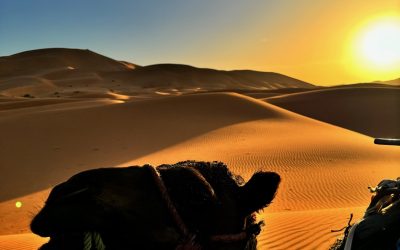
What they are. Erg Chebbi is a compact sand sea rising from a flat, dark stony plain. Its highest ridges reach around 150 metres, and the sand shifts from pale gold at midday to deep orange and red at sunset.
The camel ride. The usual way into the dunes is a camel ride of under an hour from the edge of the sand to your camp, timed for sunset or sunrise. It is slow and rhythmic rather than difficult, though stiff the next morning. If you would rather not ride, camps can bring you in by 4x4.
On foot. Climbing a high dune is the moment most people remember. Soft sand makes it slower than it looks: go up along the ridge line rather than straight up the face, and give yourself time before the light goes. For the riding options in detail, see our guide to camel treks and 4x4 desert experiences.
Book your camp before you arrive. On the approach to Merzouga you may be flagged down by men on motorbikes claiming your camp is full or closed. Do not stop; call your host directly.
Where to Stay: Camp or Hotel
You have two kinds of choice in Merzouga, and the best stays use both.
A camp in the dunes. Tented camps set among the dunes, reached by camel or 4×4. The good ones have private bathrooms with hot showers inside each tent, real beds and heating in winter; the basic ones share facilities and sit close to the road. This is the night you came for.
A hotel at the edge of the dunes. Kasbah-style hotels and guesthouses along the edge of the sand in Merzouga and Hassilabied, many with pools, gardens and terraces facing the dunes. They are the right base for a second night, for families and for the hottest months.
The split stay. If you have two nights, spend the first at a hotel on the edge to rest after the drive, then ride into a dune camp the following afternoon for dinner, the stars and sunrise.
What separates a genuinely comfortable camp from a basic one is set out in our guide to what to expect from a luxury Sahara desert camp.
Beyond the Dunes: What to See Around Merzouga

Many visitors leave after one night in the dunes. A full extra day shows you the villages, oases and market towns that give the region its character.
| Distance from Merzouga | Best for | |
|---|---|---|
| Khamlia | About 7 km south | Gnawa music and the story of the families who keep it |
| Dayet Srji | Just west of the village | Waterbirds, sometimes flamingos, when the lake holds water |
| Rissani | About 40 km north | The souk, Sijilmassa and the old ksour of the Tafilalet |
| Erfoud | About 60 km north | Fossil workshops and the date palms of the Ziz |
| Hassilabied | About 4 to 5 km north | Irrigated gardens and the quieter northern edge of the dunes |
Khamlia and its Gnawa music. A small village about seven kilometres south of Merzouga, home to families descended from people brought across the Sahara from sub-Saharan Africa. Their Gnawa music, built on the three-stringed guembri bass and the metal castanets called qraqeb, is hypnotic and deeply spiritual. Local groups such as Les Pigeons du Sable play for visitors over mint tea; a tip or buying their music is expected and goes straight to the village.
Dayet Srji. A seasonal salt lake just west of Merzouga. In dry years it is a cracked, empty basin. After rare winter rains it can hold water for a while, and then waterbirds arrive, sometimes flamingos, mostly in late winter and spring, with the dunes behind them.
The Hassilabied gardens. North of Merzouga, small plots of palms and crops are irrigated by underground water drawn from beneath the dunes and shared out by rotation. A walk through them with a local guide shows how the oasis has always worked.
Rissani. About forty kilometres north, beside the ruins of Sijilmassa, once a great terminus of the caravan trade across the Sahara. Sunday is the main market day, when the souk fills with farmers, livestock and spices. The mausoleum of Moulay Ali Cherif, ancestor of Morocco’s ruling Alaouite dynasty, is nearby; non-Muslims can visit the courtyard but not the tomb. Try medfouna, a stuffed flatbread that is the town’s signature dish.
Erfoud and the fossils. The workshops around Erfoud cut and polish fossils from the surrounding hills. Our guide to Sahara fossils, real and fake explains what you are looking at before you buy.
When to Go and Practical Matters
Season changes the Sahara more than anything else, and the nights catch out most first-time visitors.
October to November. The most comfortable season: warm days, mild nights and calm air.
March to April. Warm and bright, with occasional spring winds that can raise sand in the afternoon.
December to February. Clear and cold. In January, days average around 18°C and nights fall to around 4°C, so book a camp that heats its tents.
June to August. Very hot, with daytime highs around 40 to 45°C. If you come in summer, stay in a hotel with a pool and go into the dunes only at dawn and dusk.
Pack for both extremes. A warm layer for the evening in every season, a proper jacket in winter, sunglasses and sunscreen, and a scarf to keep sand off your face. Light trainers are better on the dunes than heavy boots. For month-by-month detail, see our guide to the best time to visit the Sahara Desert.

Cash. Merzouga has a single ATM, which is not always reliable. Take out dirhams in Erfoud or Rissani on the way. Better hotels and camps take cards; village shops, guides and musicians expect cash.
Phone signal. Usually available near the villages, patchy in the dunes. Expect to be offline for the night in camp.
Respect. Dress modestly in the villages and ask before photographing people.
Frequently Asked Questions
- How many days do you need in Merzouga?
- Two nights is ideal: one in a camp in the dunes and one in a hotel at their edge, with a free day to visit Khamlia, Rissani or the surrounding oases. One night is possible but leaves little time beyond sunset and sunrise.
- How do you get to Merzouga from Marrakech?
- By road, about 560 kilometres and around nine hours of driving before stops, over the Tizi n’Tichka pass and through the Dades valley. Split it over two days. Flights to Errachidia, about two hours from Merzouga, are the alternative.
- Is Merzouga safe?
- Merzouga is a quiet, welcoming village, and ordinary precautions apply as anywhere. The main nuisance is unofficial touts on the approach road; book your camp in advance and deal only with your host.
- Can I drive a normal car to Merzouga?
- Yes. The road is paved all the way from Marrakech, Fes and Errachidia. Leave the car at your hotel or camp base, and never drive onto the dunes.
- What is the best time to visit Merzouga?
- October to November and March to April, when days are warm and nights are mild. Winter is clear and cold at night; summer is very hot.
- Is there more to do than the camel ride?
- Yes: Gnawa music in Khamlia, the seasonal lake at Dayet Srji, the market and history of Rissani, the fossil workshops of Erfoud and walks through the oasis gardens.
Plan Your Visit to Merzouga
Tell us four things and we will do the rest:
- Your dates, or the month you have in mind
- How many are travelling, and any children’s ages
- How many days you have in Morocco, and where you arrive and leave from
- Which desert you have in mind, if any
We will send back a route with honest drive times, where you would sleep each night, and a price for your party. If it is not right, tell us and we will redraw it. There is no cost and no obligation at this stage.
Prefer to browse first? Our luxury Morocco tours page covers countrywide journeys, private Sahara tours covers the desert in depth, and luxury Morocco holidays sets out the longer itineraries.
Email: soufiane@wanderlustmorocco.com
Phone: +212 645 870 467
WhatsApp: +212 645 870 467
Soufiane
founder of Wanderlust Morocco
I’m Soufiane, founder of Wanderlust Morocco and your dedicated designer of bespoke luxury journeys through my homeland.
Having traveled extensively from New Zealand and Australia to Canada, Japan, Europe and beyond I’ve experienced many forms of hospitality, comfort, and cultural richness. These global journeys didn’t teach me what Morocco lacks they deepened my appreciation for the beauty, luxury, and soul that already thrive here.
With Wanderlust Morocco, my mission is to reveal Morocco’s true elegance through intimate, personalized experiences that highlight its refined traditions, world-class accommodations, and unforgettable landscapes. I don’t bring luxury to Morocco; I bring you to the luxury that has always been here just waiting to be experienced the right way.
Each journey is crafted with heart, care, and the highest level of detail. Rooted in love for my country and shaped by a global perspective, every itinerary is designed to feel meaningful, seamless, and uniquely yours.