Amazigh Culture in the Moroccan Sahara: Traditions, Music and Daily Life
In the south of Morocco, Amazigh culture is not a museum piece. It is spoken at the market, sung at weddings, built into the walls of the villages and served at every table.

- Soufiane
- 11/11/2026
- Wanderlust Morocco
- 4.9/5 493
The Amazigh, often called Berbers in English, are the original peoples of North Africa. Their language, music and ways of building and living shaped Morocco long before the arrival of Arabic, and they remain at the heart of the country’s identity today, nowhere more visibly than in the valleys and oases on the edge of the Sahara.
This guide is about the culture you can see and hear on a journey through the south: the language on the road signs, the rhythms of the drums, the dishes baked in the sand, the earthen villages and the craftsmanship of carpets and silver. It also covers the simple customs that make a visit to a family or a village a respectful one.
Interested in music, crafts or village life? Tell us, and we will shape the days around meeting the people who keep these traditions alive, at a pace that suits them as well as you.
The Short Answer
What to know about Amazigh culture before you travel south.
- Who. The Amazigh are the indigenous peoples of North Africa. In the southeast of Morocco, many belong to long-established tribal confederations, such as the Ait Atta.
- The language. Tamazight has been an official language of Morocco since the 2011 constitution, written in the ancient Tifinagh script.
- The new year. Yennayer, the Amazigh new year in mid-January, became a national public holiday in Morocco, first celebrated as such in 2024.
- What you will notice. Earthen ksour and kasbahs, drum and song at gatherings, bread baked in the sand, carpets and silver jewellery.
- The rule. Hospitality is generous; respond to it with patience, modest dress and a request before every photograph.

- Many cultures, not one. Amazigh life varies from the Rif to the Atlas and the Sahara, in dialect, dress, music and food.
A Living Heritage
| What it is | Where you may meet it | |
|---|---|---|
| Language | Tamazight, written in Tifinagh | Road signs, public buildings and daily conversation |
| Music | Drums, frame drums and call-and-response song | Weddings, festivals and evenings in camp |
| Food | Breads, tagines and slow-cooked dishes | Family tables, village kitchens and desert camps |
| Building | Rammed earth and mud brick | Ksour, kasbahs and village houses in the valleys |
| Craft | Weaving, carpets and silver jewellery | Cooperatives, markets and family workshops |
For the history of the desert peoples, the caravan trade and nomadic life, see our guide to who lives in the Moroccan Sahara.

Language, Script and the New Year
Tamazight. Amazigh languages are spoken by millions of Moroccans, in several regional varieties. In 2011, the new constitution made Tamazight an official language of the state alongside Arabic, a recognition that had been sought for decades.
Tifinagh. The script, with its geometric letters of circles, lines and crosses, has ancient roots in North Africa and the Sahara. Today you will see it on road signs, ministries and schools, often next to Arabic and French, and sometimes woven into textiles or engraved on jewellery.
Yennayer. The Amazigh new year falls in mid-January, on the 13th or 14th depending on the community, and follows the agricultural calendar. Families share a special meal, often with grains and dried fruit. In 2023, Morocco declared Yennayer a paid national holiday, celebrated officially for the first time in January 2024.
A few words help. A simple azul, hello in Tamazight, or tanmirt, thank you, is always warmly received, even if your guide does the rest of the talking.
Music and Celebration
Ahidous and ahwash. Two of the great collective dances of Amazigh Morocco. In ahidous, associated with the Middle and eastern High Atlas, men and women form long lines shoulder to shoulder, swaying to frame drums and sung verses. Ahwash, rooted in the High Atlas and the south, gathers dancers and poets in a circle around a fire or a courtyard.
The songs. Verses are often improvised, answering one another between singers or between two groups. Weddings, harvests and religious festivals are the natural occasions, and an invitation to watch, rather than a staged show, is something to treasure.
Gnawa in the desert. Near Merzouga, the village of Khamlia is known for its Gnawa music, carried by families whose ancestors came from West Africa. Gnawa, with its iron castanets and three-stringed bass lute, was inscribed by UNESCO in 2019 as intangible cultural heritage, and is part of the rich mix of the Moroccan south.
Music is shared, not performed on demand. At a village celebration, sit where you are invited, ask before you film and accept that some moments are meant to be watched rather than recorded.
Food of the South
The cooking of the south is shaped by the oasis and the desert: grains, dates, olive oil, slow heat and generous sharing.
Madfouna. Around Rissani and Merzouga, the local speciality is a large stuffed flatbread, filled with spiced meat, onions and herbs and baked until crisp. It is often called the “Berber pizza”, and is usually shared from the centre of the table.
Bread in the sand. In the desert, bread is sometimes baked directly in hot sand under the embers of a fire, then brushed clean and broken by hand. Watching it come out of the ground is one of the small pleasures of a camp evening.
Tea. Mint tea, sweet and poured from a height, is the language of welcome. Accepting a glass, and ideally a second, is part of every visit.
For what to do on the days around the dunes, including village visits, see our guide to the best things to do in the Moroccan Sahara.
Earthen Villages and Craftsmanship

The south of Morocco is built from its own soil, and many of its crafts come from the same patient hands.
| The craft | What to look for | |
|---|---|---|
| Ksar and kasbah | Fortified earthen villages and family strongholds | Decorated towers, narrow lanes and shaded passageways |
| Carpets | Hand-knotted and flat-woven rugs | Natural wool, irregular motifs and the weaver’s own story |
| Silver | Jewellery, fibulae and amulets | Geometric engraving, enamel and coloured stones |
| Pottery | Everyday vessels and tagine dishes | Simple shapes, made for use rather than display |
| Henna | Patterns on hands for celebrations | Designs that vary by region and occasion |
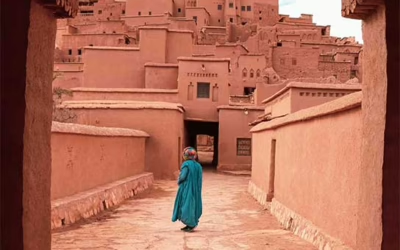
Earth that breathes. Rammed earth and mud brick keep houses cool in summer and warm in winter, but they need constant care: a wall left without maintenance can melt back into the land within a few rainy seasons. Many old ksour are now partly empty, while families live in newer houses nearby. Our guide to Ait Ben Haddou and Ouarzazate covers the best-known earthen sites on the road south.
Buying well. Cooperatives, often run by women, are a good place to buy carpets and textiles, and the price usually reaches the makers more directly. Take your time, ask how a piece was made and never feel obliged to buy.
Visiting Respectfully
Amazigh hospitality is famous, and it rests on simple courtesies that are easy to return.
Dress. In villages, cover shoulders and knees. It is a sign of respect, and it is also the most comfortable way to dress in the sun.
Photographs. Always ask before photographing people, especially women and children, and accept a refusal with a smile. Your guide can ask for you.
At the table. Wait to be invited to sit, eat with your right hand from the side of the dish nearest you and leave a little on the plate to show you have had enough.
Gifts. If you are invited into a home, a small gift such as sugar, tea or fruit is a traditional gesture. Ask your guide what is appropriate rather than giving money directly, especially to children.

With a local guide. A guide from the region turns a visit into a conversation, translating not only words but customs, and knowing which families welcome visitors and when.
Plan the route. Village visits fit naturally into the days on the road to the dunes. Our guide on how to plan a luxury Morocco trip explains how to build them into a full itinerary.
Frequently Asked Questions
- What is Amazigh culture?
- It is the culture of the Amazigh, the indigenous peoples of North Africa, including their languages, music, food, architecture, crafts and customs. In Morocco it is especially visible in the Atlas mountains and the south.
- Is Tamazight an official language in Morocco?
- Yes. Since the 2011 constitution, Tamazight has been an official language of Morocco alongside Arabic. It is written in the Tifinagh script, which you will see on road signs and public buildings.
- When is Yennayer, the Amazigh new year?
- Yennayer falls in mid-January, on the 13th or 14th depending on the community. It became a national public holiday in Morocco and was first celebrated as such in January 2024.
- What music is traditional in the Moroccan Sahara?
- Collective Amazigh dances such as ahidous and ahwash, with frame drums and sung verses, and, near Merzouga, the Gnawa music of the village of Khamlia.
- What is madfouna?
- A large stuffed flatbread filled with spiced meat, onions and herbs, a speciality of Rissani and Merzouga, often called the Berber pizza.
- How should I behave when visiting an Amazigh village?
- Dress modestly, ask before taking photographs, accept tea when offered and let your guide advise you on gifts and customs.
Meet the Culture of the Moroccan South
Tell us four things and we will do the rest:
- Your dates, or the month you have in mind
- How many are travelling, and any children’s ages
- How many days you have in Morocco, and where you arrive and leave from
- Which desert you have in mind, if any
We will send back a route with honest drive times, where you would sleep each night, and a price for your party. If it is not right, tell us and we will redraw it. There is no cost and no obligation at this stage.
Prefer to browse first? Our luxury Morocco tours page covers countrywide journeys, private Sahara tours covers the desert in depth, and luxury Morocco holidays sets out the longer itineraries.
Email: soufiane@wanderlustmorocco.com
Phone: +212 645 870 467
WhatsApp: +212 645 870 467
Soufiane
founder of Wanderlust Morocco
I’m Soufiane, founder of Wanderlust Morocco and your dedicated designer of bespoke luxury journeys through my homeland.
Having traveled extensively from New Zealand and Australia to Canada, Japan, Europe and beyond I’ve experienced many forms of hospitality, comfort, and cultural richness. These global journeys didn’t teach me what Morocco lacks they deepened my appreciation for the beauty, luxury, and soul that already thrive here.
With Wanderlust Morocco, my mission is to reveal Morocco’s true elegance through intimate, personalized experiences that highlight its refined traditions, world-class accommodations, and unforgettable landscapes. I don’t bring luxury to Morocco; I bring you to the luxury that has always been here just waiting to be experienced the right way.
Each journey is crafted with heart, care, and the highest level of detail. Rooted in love for my country and shaped by a global perspective, every itinerary is designed to feel meaningful, seamless, and uniquely yours.