Fossils of Morocco: Exploring the Ancient Geological Heritage Near the Sahara
On the road to the Sahara, the rocks tell a story far older than the dunes: of warm seas, great rivers and creatures that lived hundreds of millions of years ago.
- Soufiane
- 11/11/2026
- Wanderlust Morocco
- 4.9/5 493
Southeastern Morocco is one of the richest regions on Earth for fossils. Long before the Sahara, much of this land lay under shallow seas, then later carried rivers and floodplains. Each era left its layer of rock, and in the dry climate of the south, erosion has laid those layers open to the sky.
This guide reads the landscape the way a geologist might on a journey toward the dunes: which rocks belong to which age, what lived in them, and where travellers can see that heritage for themselves, from the workshops of Erfoud to the escarpments near the desert. It is written for curious visitors rather than specialists.
Interested in geology or fossils? Tell us, and we will build time for workshops and landscapes into your route, with a guide who can explain what you are looking at.
The Short Answer
The essentials of Morocco’s fossil country.
- Where. The southeast, between the Anti-Atlas mountains and the edge of the Sahara, around Erfoud, Rissani, Alnif and toward the Algerian border.
- What. Marine life from ancient seas, such as trilobites, orthoceras and ammonoids, and, in younger rocks, the remains of river creatures and dinosaurs.
- How old. From around 480 million years for the oldest well-known sites to around 95 million years for the river beds of the Kem Kem.
- Where to see it. In polishing workshops, in the floors and tables made from fossil stone, and in the landscape itself on the way to the dunes.
- The rule. Admire freely, buy carefully and leave important finds to science.
- The dunes are young. The sand seas of Erg Chebbi and Erg Chigaga are geologically recent, piled up by wind on top of a far older stony land.

Layers of Time on the Road South
| How old | What it holds | |
|---|---|---|
| Ordovician | Around 480 million years | Early sea life, including rare soft-bodied animals near Zagora |
| Devonian | Around 400 to 360 million years | Limestone full of trilobites, orthoceras and ammonoids |
| Cretaceous | Around 100 to 95 million years | River sands of the Kem Kem, with fish, crocodile relatives and dinosaurs |
| Today | Recent geological times | Wind-blown dunes, stony hamada plains and oasis valleys |
Ages are rounded. Geologists date each formation more precisely, and dates are refined as research continues.

The Ancient Seas
A sea before the desert. For long stretches of the Palaeozoic era, hundreds of millions of years ago, the southeast of Morocco lay on the edge of a shallow sea. Mud and lime settled on its floor, burying the animals that lived and died there, and slowly turned to rock.
The Fezouata near Zagora. Rocks of the Early Ordovician, around 480 million years old, in the Zagora region have become famous among scientists for preserving not only shells but also soft-bodied animals, a rare window on early life in the sea.
The Devonian limestones. Later, in the Devonian, the seas were rich in trilobites, the straight-shelled orthoceras and coiled ammonoids. Their limestones form the dark hills around Erfoud and Alnif, and they are the source of most of the fossils you will see on sale in the region.
For a deeper look at the Devonian sea, the trilobite trade and how to tell real fossils from reproductions, see our traveller’s guide to Morocco Sahara fossils.
The Age of Rivers and Giants
The Kem Kem. Much later, in the Cretaceous, a great river system crossed the region. Its sands and gravels, now exposed along escarpments near the Algerian border, are known as the Kem Kem beds, around 100 to 95 million years old.
What lived there. The rivers teemed with large fish, and their banks were home to crocodile relatives, flying reptiles and predatory dinosaurs. The Kem Kem is best known for Spinosaurus, a giant, fish-eating dinosaur closely tied to water, whose fossils have been studied here by international research teams.
For visitors. The Kem Kem is a working landscape for local fossil diggers and a research area for scientists, not a visitor site with paths and signs. Seen from the road or with a specialist guide, its long escarpments are still a striking sight.
Do not expect a museum in the desert. Most fossil heritage in the region is seen in workshops, shops and open landscape, not in signposted parks. A good guide makes all the difference.
Erfoud and the Fossil Workshops
Erfoud, on the road to Merzouga, is the centre of the fossil trade in Morocco and the easiest place to see the work up close.
From quarry to table. Blocks of dark Devonian limestone are cut into slabs, then ground and polished until the fossils inside appear: the long cones of orthoceras and the spirals of ammonoids, in black, grey and cream. The result is used for tables, sinks, basins and decorative pieces.
In the workshops. A visit shows the cutting, grinding and polishing, and often the patient preparation of trilobites, freed from their rock with fine tools over many hours. Ask the craftsmen to explain each step.
Around the town. Fossil limestone also appears in local buildings and hotel floors, so keep an eye on the ground beneath your feet.
Erfoud is a natural stop on the way to the dunes. Our Merzouga travel guide covers what else to see in the area.
Reading the Landscape on Your Journey

Even without stopping at a single fossil site, the drive south is a journey through geological time.
| What you see | What it tells you | |
|---|---|---|
| The High Atlas | Folded and lifted mountains | The slow push of Africa against Europe raised these ranges over millions of years |
| Gorges | Deep canyons such as the Dades and Todra | Rivers cutting down through layered rock as the land rose |
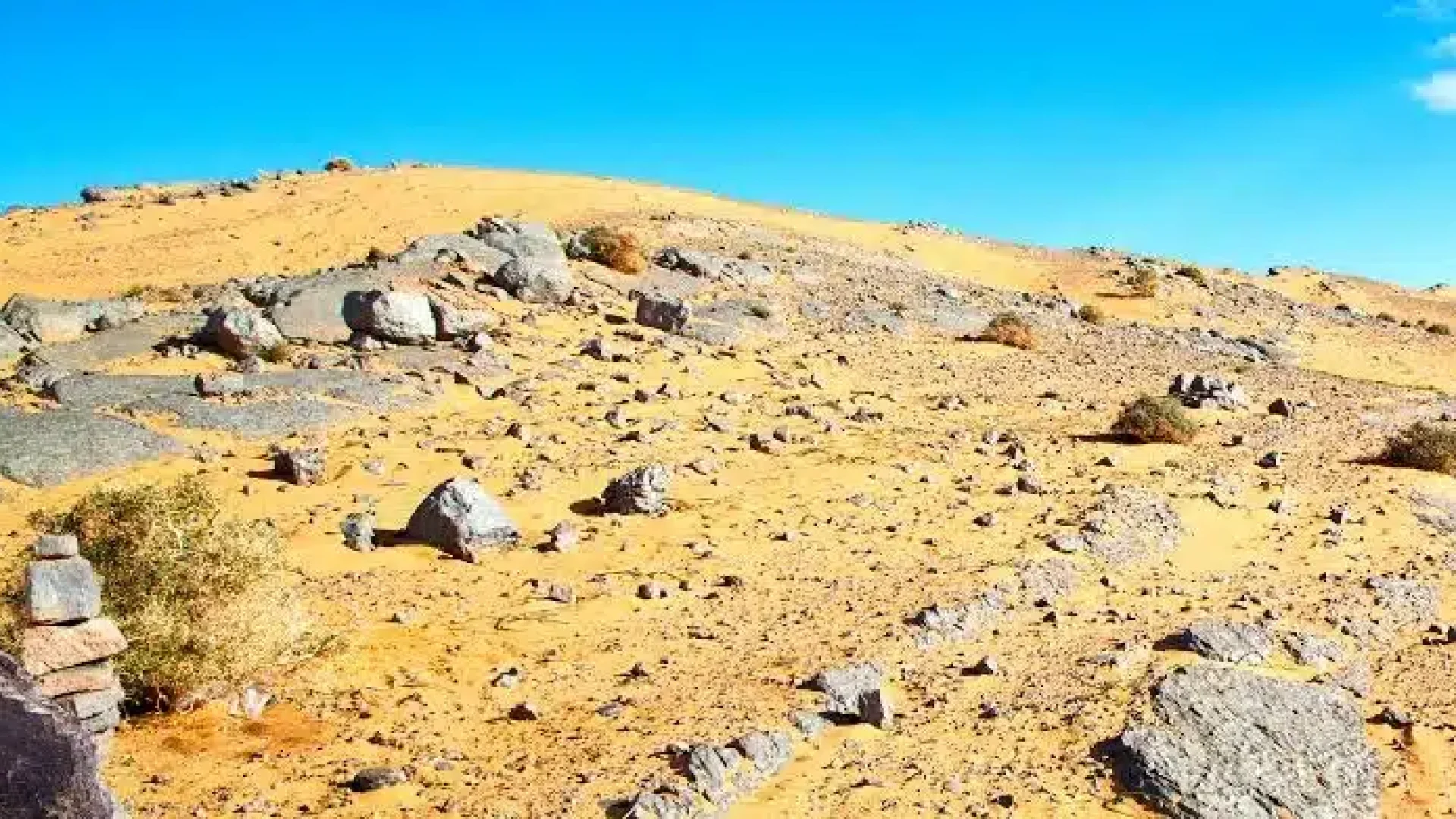
| Hamada | Flat plains of dark stone | Old rock surfaces stripped of sand by the wind |
| Black hills | Low ridges around Erfoud and Alnif | Devonian marine limestone, rich in fossils |
| The dunes | Erg Chebbi rising from the plain | Young sand gathered by the wind on top of ancient ground |
Ask your driver to stop. Roadside viewpoints over the gorges and the hamada are often the best geology lessons of the trip, and photographs of the layered cliffs explain more than any book. Our guide to the Marrakech to Merzouga drive lists the best places to break the journey.
Desert varnish. Notice the dark sheen on many rocks of the hamada. This coating forms very slowly on exposed stone in dry climates and is one reason the plains look so dark beside the golden sand.
Fossils and Responsible Travel
Fossils are part of Morocco’s natural heritage and of the livelihood of many families in the south. Both deserve respect.
Buy from established sellers. Workshops and shops with a fixed address can tell you where a piece came from and how it was prepared. Ask for a receipt for anything of value.
Know what you are buying. Many pieces are restored or partly reconstructed, and some are reproductions. Honest sellers will tell you which, and a fair price reflects it.
Check the rules. Rules can apply to important specimens and to bringing fossils into your own country. Ask before buying anything large or rare.
Leave important finds in place. Bones and rare specimens found in the field are of value to science. If you see something remarkable, photograph it and tell your guide rather than taking it.
Combine geology with the desert. A day around Erfoud and Rissani fits easily into a stay near the dunes. Our guide to the best things to do in the Moroccan Sahara suggests how to balance it with camel rides and village visits.
Plan the time. If fossils are a real interest, allow an extra night in the region. Our guide on how many days you need in Morocco helps you shape the whole route.

Frequently Asked Questions
- Where are the best fossils in Morocco?
- In the southeast, around Erfoud, Rissani and Alnif, on the edge of the Sahara. The region is known for Devonian marine fossils and, near the Algerian border, the Cretaceous Kem Kem beds.
- How old are the fossils near the Sahara in Morocco?
- They range from around 480 million years for Ordovician sites near Zagora to around 400 to 360 million years for the Devonian limestones, and around 100 to 95 million years for the Kem Kem beds.
- Why is Erfoud famous for fossils?
- Erfoud lies among Devonian limestone hills full of marine fossils, and it is the centre of the workshops that cut, polish and prepare them.
- What is the Kem Kem in Morocco?
- A group of Cretaceous river deposits along escarpments in southeastern Morocco, known for fossils of large fish, crocodile relatives and dinosaurs such as Spinosaurus.
- Can you visit fossil workshops near Merzouga?
- Yes. Workshops in and around Erfoud, on the road to Merzouga, show how fossil limestone is cut and polished and how trilobites are prepared.
- Is it legal to buy fossils in Morocco?
- Fossils are sold openly in the region, but rules can apply to important specimens and to importing them at home. Buy from established sellers, keep receipts and ask before buying anything large or rare.
Add Deep Time to Your Desert Journey
Tell us four things and we will do the rest:
- Your dates, or the month you have in mind
- How many are travelling, and any children’s ages
- How many days you have in Morocco, and where you arrive and leave from
- Which desert you have in mind, if any
We will send back a route with honest drive times, where you would sleep each night, and a price for your party. If it is not right, tell us and we will redraw it. There is no cost and no obligation at this stage.
Prefer to browse first? Our luxury Morocco tours page covers countrywide journeys, private Sahara tours covers the desert in depth, and luxury Morocco holidays sets out the longer itineraries.
Email: soufiane@wanderlustmorocco.com
Phone: +212 645 870 467
WhatsApp: +212 645 870 467
Soufiane
founder of Wanderlust Morocco
I’m Soufiane, founder of Wanderlust Morocco and your dedicated designer of bespoke luxury journeys through my homeland.
Having traveled extensively from New Zealand and Australia to Canada, Japan, Europe and beyond I’ve experienced many forms of hospitality, comfort, and cultural richness. These global journeys didn’t teach me what Morocco lacks they deepened my appreciation for the beauty, luxury, and soul that already thrive here.
With Wanderlust Morocco, my mission is to reveal Morocco’s true elegance through intimate, personalized experiences that highlight its refined traditions, world-class accommodations, and unforgettable landscapes. I don’t bring luxury to Morocco; I bring you to the luxury that has always been here just waiting to be experienced the right way.
Each journey is crafted with heart, care, and the highest level of detail. Rooted in love for my country and shaped by a global perspective, every itinerary is designed to feel meaningful, seamless, and uniquely yours.