Erg Chebbi vs Erg Chigaga: Which Sahara Desert Is Best for Your Morocco Trip?
Morocco has two great sand seas, and they make for two very different trips. One is reached by paved road and fits a Marrakech to Fes route; the other is reached by desert track and rewards the extra effort with solitude.

- Soufiane
- 11/11/2026
- Wanderlust Morocco
- 4.9/5 493
Ask for “the Sahara” in Morocco and you will be sent to one of two places. Erg Chebbi rises beside the village of Merzouga in the east. Erg Chigaga lies beyond the end of the road at M’Hamid El Ghizlane in the south. Both are genuine ergs, seas of wind-blown sand, and both are spectacular.
The difference is in everything around the dunes: how you get there, what the rest of your route looks like, how many other people share the view, and how comfortable the camp can be. Choose the dune field that fits your itinerary and you will remember the desert. Choose the wrong one and you may mostly remember the drive.
Tell us your dates, how long you have and where you land. We will tell you which dune field fits, with honest drive times.
The Short Answer
If you want a single sentence: Erg Chebbi is the easier and more versatile choice, and Erg Chigaga is the wilder one. The rest of this guide explains when each answer changes.
Choose the dune field that matches your route and your appetite for the journey:
- Choose Erg Chebbi if this is your first trip to Morocco, if you are travelling between Marrakech and Fes, if anyone in your group dislikes rough tracks, or if you want the widest choice of comfortable camps.
- Choose Erg Chigaga if solitude and dark skies matter more to you than convenience, if your trip starts and ends in Marrakech, and if a few hours of off-road driving sounds like part of the adventure rather than a cost.
- Choose neither if you have fewer than four days for the desert. The Agafay, about forty-five minutes from Marrakech, gives you a night under canvas without the long drive, though it is a stone desert without sand dunes.

- Decide with your flights in front of you. Where you arrive and leave from settles this question more often than the dunes do.
Side by Side
| Erg Chebbi | Erg Chigaga | |
|---|---|---|
| Gateway | Merzouga, in the Tafilalet | M’Hamid El Ghizlane, at the end of the Draa valley |
| Last stretch | Paved road to the edge of the dunes | Track of two to three hours by 4×4 |
| Size | About 28 km long and 5 to 7 km wide | Morocco’s largest erg, spread over a much wider area |
| Highest dunes | Around 150 metres | Lower; some dunes rise more than 50 metres above the plain |
| From Marrakech | About 560 km, around 9 hours of driving | About 7.5 to 8 hours to M’Hamid, then the track |
| Fits a Marrakech–Fes route | Yes, without backtracking | No; it is a loop from Marrakech |
| Number of camps | Many, from basic to very comfortable | Few, spread across a large area |
| Night sky | Very dark, with faint light from nearby villages | Darker still, with almost nothing on the horizon |
Both are worth the journey. The question is which journey suits the rest of your trip.

Erg Chebbi: The Accessible Sand Sea
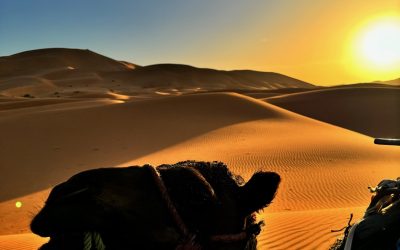
The dunes people picture. Erg Chebbi rises steeply from a flat stony plain, about 28 kilometres from north to south, with ridges reaching around 150 metres. The sand is a deep orange that turns almost red at sunset, and its compact shape makes the dunes feel enormous when you stand at their foot.
Easy to reach. A paved road runs through Erfoud and Rissani to Merzouga, and on to the edge of the sand. Your vehicle stays on tarmac until the last few minutes, and the camel ride or 4x4 transfer into camp is short.
The trade-off is company. The villages of Merzouga and Hassilabied sit along its western edge, and Erg Chebbi is the busiest dune field in the country. The better camps are set back in the dunes, away from the clusters near the road, and that choice matters more here than anywhere.
Its great advantage is the route. Erg Chebbi lies on the way between Marrakech and Fes: over the High Atlas to the dunes, then north through the Ziz valley and the Middle Atlas, without driving the same road twice.
Erg Chigaga: The Remote Sand Sea
Beyond the end of the road. Erg Chigaga lies roughly 56 kilometres southwest of M’Hamid El Ghizlane, where the tarmac stops. The last stretch is a track across stony plains and dry riverbeds that takes two to three hours by 4x4, depending on conditions.
Space and silence. Erg Chigaga is Morocco’s largest erg. Its dunes are lower than Erg Chebbi’s, with some rising more than 50 metres, but they spread far wider, with the hills of the Jbel Bani on the horizon. There are no villages at the edge of the sand, a handful of camps spread far apart, and far fewer visitors than at Erg Chebbi.
The trade-off is effort. The track is bumpy and dusty, and hard going for anyone with back trouble or motion sickness. The route is a loop from Marrakech, usually through the Draa valley and back via Foum Zguid, so it does not connect to Fes.
Never self-drive to Erg Chigaga. The track is unmarked in places, there is little or no phone signal, and soft sand needs the right vehicle and experience. Erg Chebbi can be reached in an ordinary car; Erg Chigaga cannot.
The Drive Decides More Than the Dunes
Both dune fields are a long way from Marrakech. How you pace the drive is what decides whether the desert feels like a highlight or an ordeal.
To Erg Chebbi: two days from Marrakech. About 560 kilometres and around nine hours of driving before stops, over the Tizi n’Tichka pass at 2,260 metres. Split it with a night in Skoura or the Dades valley, and you arrive in Merzouga in time for sunset.
From Erg Chebbi: one day to Fes. About 460 kilometres and around seven hours, north through the Ziz valley, Midelt and the Middle Atlas. This is what makes the classic Marrakech to Fes route work.
To Erg Chigaga: two days, then the track. About seven and a half to eight hours from Marrakech to M’Hamid through Ouarzazate and the Draa valley, usually with a night in Agdz or Zagora, then two to three hours off-road.
The winter caveat. Snow closes the Tizi n’Tichka for a few hours at a time between November and March; it happened twice in January 2026. It affects both routes from Marrakech, so leave slack in winter itineraries.
For the full planning sequence, including how many nights to spend in the dunes, see our guide to building a custom Sahara desert itinerary.
Desert Camps Compared

There are comfortable camps in both deserts. What differs is how much can be brought in, and how many neighbours you will have.
| Erg Chebbi | Erg Chigaga | |
|---|---|---|
| Choice of camps | Wide, from basic to very comfortable | Small; a few camps spread far apart |
| Water and power | Easier to supply by road; reliable hot showers at good camps | Brought in by track; managed more carefully |
| Neighbours | Other camps may be within sight unless you choose carefully | Usually none in view |
| Getting in | Short camel ride or 4×4 transfer | The track itself; camels for sunset rides at camp |
Ask the same questions in either desert. Is the bathroom inside the tent, with a flushing toilet and hot water? How is it heated in winter? Is there a generator? How many tents, and how far from the next camp? Our guide to what to expect from a luxury Sahara desert camp goes through each of them.
Check the season. Summer heat is extreme in both deserts, and some camps close in the hottest months. Most Erg Chigaga camps close from June until about mid-September.
Which Desert Suits Which Traveller
Most travellers are better served by one dune field than the other. These are the patterns we see most often.
First visit to Morocco: Erg Chebbi. It fits the classic route, and the dunes are the ones you came to see.
Travelling Marrakech to Fes, or the reverse: Erg Chebbi, every time. Erg Chigaga would add two days of backtracking.
Families with young children, or anyone who dislikes rough roads: Erg Chebbi. The paved access makes a real difference.
Honeymooners: either. Erg Chebbi for the most comfortable camps, Erg Chigaga for the feeling of being alone.
Stargazers and photographers: Erg Chigaga, for the darkest skies and the emptiest horizons.
Return trips to Morocco: Erg Chigaga, if you have already seen Erg Chebbi and want something quieter.

Can you do both? In principle, yes, by a long off-road crossing between the two. In practice it needs a lot of days and a lot of driving, and most travellers enjoy one dune field more than two in a hurry.
Frequently Asked Questions
- Is Erg Chebbi or Erg Chigaga better?
- Neither is better in every case. Erg Chebbi is easier to reach, fits a Marrakech to Fes route and has the widest choice of comfortable camps. Erg Chigaga is more remote and quieter, with darker skies, but needs a two to three hour 4×4 track and a loop back to Marrakech.
- Which desert has the bigger dunes?
- Erg Chebbi has the taller dunes, with ridges reaching around 150 metres. Erg Chigaga is the larger erg by area, but its dunes are lower, with some rising more than 50 metres above the surrounding plain.
- How long does it take to get to Erg Chigaga from Marrakech?
- About seven and a half to eight hours of driving to M’Hamid El Ghizlane, usually split over two days, followed by two to three hours on a desert track by 4×4.
- Can we drive ourselves to the desert?
- To Erg Chebbi, yes: the road is paved all the way to Merzouga, though you should leave the car at your hotel or camp base and never drive onto the dunes. To Erg Chigaga, no: the track needs an experienced desert driver and a suitable 4×4.
- Which desert is better for stargazing?
- Both are excellent on a clear, moonless night. Erg Chigaga has the edge, because there are no villages near the dunes and almost nothing lights the horizon.
- Can we visit both on one trip?
- It is possible with an off-road crossing between them, but it takes several extra days of hard driving. Most travellers are happier choosing one.
Plan Your Sahara Journey
Tell us four things and we will do the rest:
- Your dates, or the month you have in mind
- How many are travelling, and any children’s ages
- How many days you have in Morocco, and where you arrive and leave from
- Which desert you have in mind, if any
We will send back a route with honest drive times, where you would sleep each night, and a price for your party. If it is not right, tell us and we will redraw it. There is no cost and no obligation at this stage.
Prefer to browse first? Our luxury Morocco tours page covers countrywide journeys, private Sahara tours covers the desert in depth, and luxury Morocco holidays sets out the longer itineraries.
Email: soufiane@wanderlustmorocco.com
Phone: +212 645 870 467
WhatsApp: +212 645 870 467
Soufiane
founder of Wanderlust Morocco
I’m Soufiane, founder of Wanderlust Morocco and your dedicated designer of bespoke luxury journeys through my homeland.
Having traveled extensively from New Zealand and Australia to Canada, Japan, Europe and beyond I’ve experienced many forms of hospitality, comfort, and cultural richness. These global journeys didn’t teach me what Morocco lacks they deepened my appreciation for the beauty, luxury, and soul that already thrive here.
With Wanderlust Morocco, my mission is to reveal Morocco’s true elegance through intimate, personalized experiences that highlight its refined traditions, world-class accommodations, and unforgettable landscapes. I don’t bring luxury to Morocco; I bring you to the luxury that has always been here just waiting to be experienced the right way.
Each journey is crafted with heart, care, and the highest level of detail. Rooted in love for my country and shaped by a global perspective, every itinerary is designed to feel meaningful, seamless, and uniquely yours.