What to Expect from a Luxury Sahara Desert Camp in Morocco
Private tents, desert dining and a night sky with nothing in it. Here is what a genuinely good camp includes, what it cannot promise, and the questions that separate one from a field of tents by the road.
- Soufiane
- 11/11/2026
- Wanderlust Morocco
- 4.9/5 493
The word luxury is used loosely in the Moroccan desert. It is attached to camps with a private bathroom, heating and a chef, and to rows of tents a short walk from the road with a shared toilet block. Both look much the same in a well-lit photograph.
This guide sets out what a luxury Sahara camp in Morocco should actually give you, from the tent itself to dinner, the night sky and the morning after, and the honest limits of sleeping in the dunes. Ask the questions below before you book any camp, ours included.
Tell us your dates and which desert you have in mind. We will tell you which camps suit the season and how the drive fits your route.
What “Luxury” Means in a Desert Camp
A desert camp is not a hotel, and the best ones do not pretend to be. What separates a luxury camp from a standard one is a short list of practical things, and every one of them can be checked before you pay.
The essentials of a genuinely comfortable night in the dunes:
- A private bathroom inside your tent. A flushing toilet, a sink and a shower with hot water, behind a partition in your own tent. Not a shared block across the sand.
- A real bed. A raised frame and a proper mattress with good linen and heavy blankets, not a foam mat on a rug.
- Heating in winter. Desert nights in December and January fall close to freezing. Ask exactly how the tent is heated: a heater, electric blankets or a hot water bottle are very different nights.
- Power that does not roar. Solar systems with batteries are quiet. A generator outside your tent is not, and it is worth asking whether one runs and until when.
- Distance from the road and from other camps. The point of the desert is the silence. A camp set back behind the dunes keeps it; a camp in a cluster beside the track does not.

- Ask for photographs of the bathroom, not the tent. It is the single detail that tells you most about how a camp is run.
Inside the Tent
| Standard camp | Luxury camp | |
|---|---|---|
| Bathroom | Shared toilet and shower block | Private bathroom inside the tent, with a flushing toilet and hot shower |
| Bed | Mattress on a low base or on the floor | Raised bed frame, proper mattress, good linen |
| Winter nights | Blankets only | Heating or electric blankets, extra bedding |
| Power | Limited hours, sometimes a generator | Solar with batteries; charging in the tent |
| Setting | Often close to the access track | Set back in the dunes, out of sight of the road |
| Dinner | Set menu at shared tables | Several courses, served with more space and privacy |
Tent sizes, finishes and menus vary from camp to camp. The bathroom, the heating and the location are what you will notice at two in the morning.

Shared Boutique Camp or Private Camp
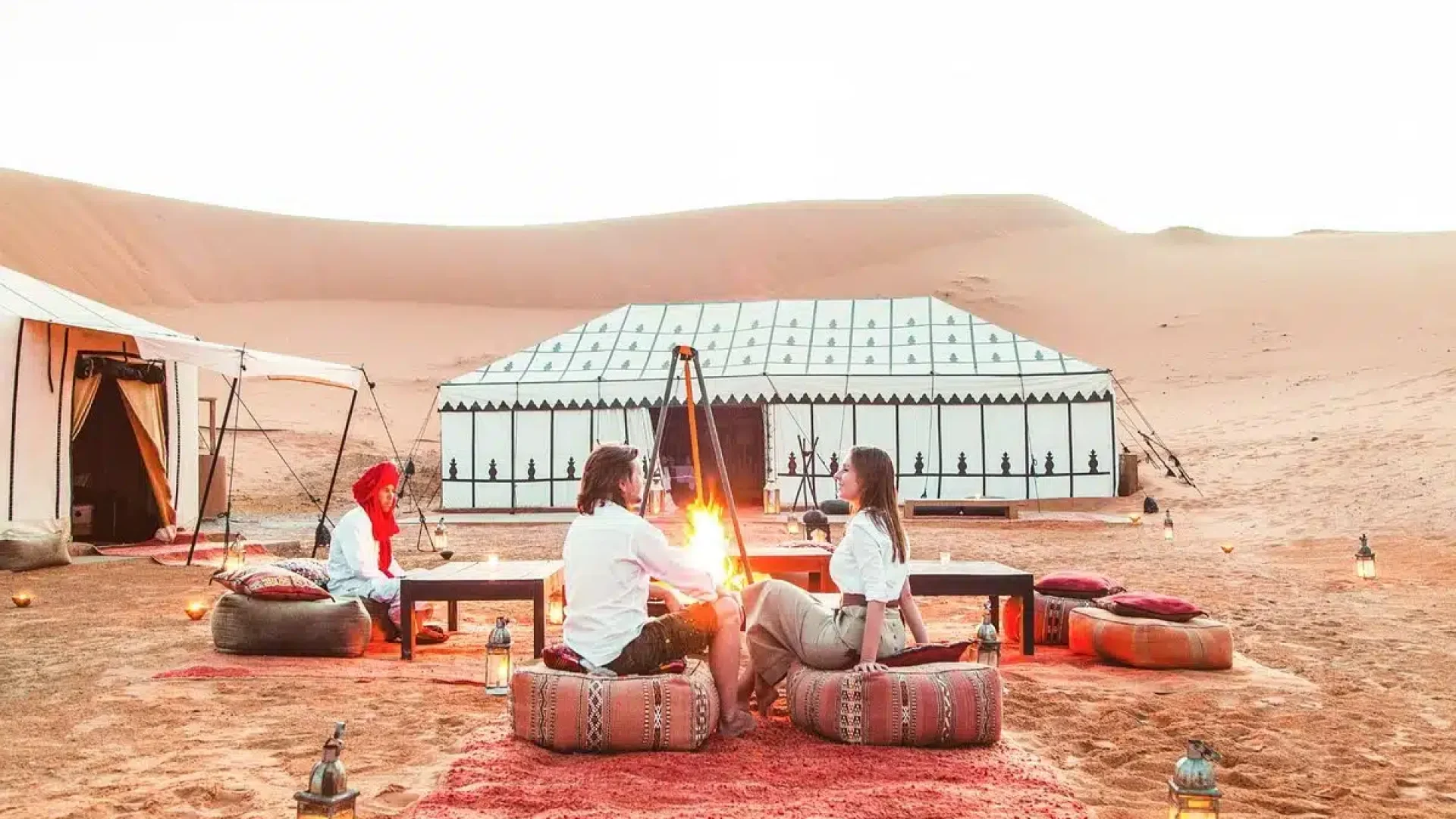
A shared boutique camp has a small number of tented suites, each with its own bathroom, spread around a dune basin, with a central dining tent and a campfire. You keep your privacy in the tent and share the evening if you want to. It suits most couples, families and solo travellers.
A private camp is set up for your party alone, with its own staff and nobody else on the site. It costs considerably more and needs more notice, and it makes most sense for a honeymoon, a celebration or a family group large enough to fill it.
A hotel on the edge of the dunes is the third option, and an underrated one. You get the dune view, a pool and air conditioning, and you can still ride or drive out to the dunes for sunset and come back to a room with solid walls.
The honest rule: one night in the dunes is enough for most people. Two nights works well if one of them is in a hotel on the edge of the sand.
Which Desert: Erg Chebbi or Erg Chigaga
Erg Chebbi, near Merzouga, has the tall orange dunes most people picture, rising to around 150 metres, and a paved road all the way to the edge of the sand. That access is why the camps there can offer reliable hot water and heating, and why the choice of camps is wider.
Erg Chigaga, beyond M’Hamid, is reached by a track of two to three hours by 4x4 across open desert. There are far fewer camps and far fewer people, and the skies are darker. Comfort is good at the better camps, but water and power are managed more carefully because everything comes in by track.
Our full comparison of Erg Chebbi vs Erg Chigaga sets out the drive times, landscapes and camps of the two dune fields side by side.
Sunset matters more than the tent. Arrive at the edge of the dunes by mid-afternoon so you reach camp with time to climb a ridge before the light goes. A late start from the road is the most common way to lose the best hour of the stay.
An Evening in Camp, Hour by Hour
Timings shift with the season and the camp, but a good evening in the dunes tends to follow the same rhythm.
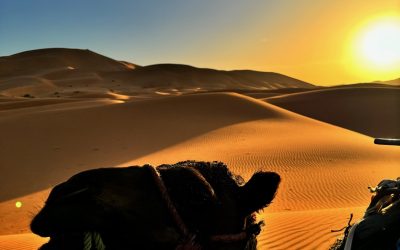
Late afternoon: the ride in. You leave the vehicle at the edge of the dunes and ride in by camel, usually under an hour, or go by 4×4 if you prefer. Luggage goes separately by vehicle.
Sunset: the ridge. Climb the nearest high dune on foot. It is harder than it looks in soft sand, and worth every step.
Evening: dinner. Usually several courses of Moroccan cooking, soup, salads, a tagine and fruit, served in a dining tent or outside on calm nights.
After dinner: the fire and the sky. Drumming and music around the campfire at many camps, then the stars. Away from the villages the Milky Way is plain to the naked eye on a clear, moonless night.
Dawn: sunrise. Up early for the light on the dunes, then breakfast and the ride or drive back out to your vehicle.
For the camel ride and the 4×4 alternatives in more detail, see our guide to private camel treks and 4×4 desert experiences.
Getting There Without Losing Two Days

The camp is the easy part. The distance is what decides whether the desert feels like the highlight of the trip or the long day you would rather forget.
| From Marrakech | From Fes | |
|---|---|---|
| Distance to Merzouga | About 560 km | About 460 km |
| Driving time | Around 9 hours before stops | Around 7 hours before stops |
| How to pace it | Two days, with a night in Skoura or the Dades valley | One long day, or a night in Midelt |
| Route | High Atlas, Ouarzazate, Dades and Todra | Middle Atlas, Midelt and the Ziz valley |
Do not do Marrakech and back in three days. The common three-day tour spends most of its time in the vehicle and drives the same road twice. If you only have three days, the Agafay desert near Marrakech is the better choice.
Use the desert as a link, not a detour. Marrakech to the dunes over two days, then on to Fes, avoids driving back over the Atlas. Our guide to building a custom Sahara desert itinerary sets out the route shapes that work.
Consider the flight. Errachidia, about two hours from Merzouga by road, has flights from Casablanca and from Marrakech. Schedules are limited and change by season, so check them before building a route around them.
Questions to Ask Before You Book
A short message to the camp or your planner will tell you more than any gallery. These are the questions worth asking, and the answers worth hearing.
Is the bathroom inside my tent? The answer should be yes, with a flushing toilet and a hot shower. “Attached” can mean a separate cabin outside.
How is the tent heated in winter? A clear answer about heaters or electric blankets is a good sign. Vagueness is not.
How many tents are in the camp, and how far apart? Small camps feel calm. Large ones feel like a village.
Can we see the road or other camps from our tent? A good camp will tell you honestly.
Is there a generator, and when does it run? Silence is the reason you came.
What is included? Dinner, breakfast, the camel ride or 4×4 transfer and soft drinks are usually included. Wine and private extras often are not.
What happens in a sandstorm or heavy rain? Good camps have a plan, and a hotel nearby they can move you to.

Can the camp handle our dietary needs? Most can with notice, because meals are cooked on site. Tell them before you arrive, not at dinner.
Is there phone signal? Often on the ridges, less in the hollows. Plan to be unreachable for an evening.
Frequently Asked Questions
- Do luxury desert tents in Morocco have private bathrooms?
- The better camps do. Each tent has its own bathroom behind a partition, with a flushing toilet, a sink and a hot shower. Always confirm this before booking, because some camps described as luxury still use shared facilities.
- How cold is a desert camp at night?
- In December and January, nights in the Moroccan Sahara can fall close to freezing. Spring and autumn nights are mild. A good camp heats the tents in winter or provides electric blankets and heavy bedding.
- How many nights should we spend in a desert camp?
- One night is enough for most travellers. If you want two nights in the desert, spending one of them in a hotel at the edge of the dunes gives you a pool, a solid room and the same sunsets.
- Which is better for a luxury camp, Erg Chebbi or Erg Chigaga?
- Erg Chebbi has the widest choice of comfortable camps and a paved road to the dunes. Erg Chigaga is more remote and quieter, with fewer camps, and is reached by a rough 4×4 track of two to three hours.
- Do we have to ride a camel to reach the camp?
- No. The camel ride is optional; most camps can bring you in by 4×4, and luggage always travels by vehicle.
- When is the best time to stay in a desert camp?
- October to November and March to April are the most comfortable. Winter is clear and cold. Summer is very hot, and some camps close during the hottest months.
Plan Your Night in the Sahara
Tell us four things and we will do the rest:
- Your dates, or the month you have in mind
- How many are travelling, and any children’s ages
- How many days you have in Morocco, and where you arrive and leave from
- Which desert you have in mind, if any
We will send back a route with honest drive times, where you would sleep each night, and a price for your party. If it is not right, tell us and we will redraw it. There is no cost and no obligation at this stage.
Prefer to browse first? Our luxury Morocco tours page covers countrywide journeys, private Sahara tours covers the desert in depth, and luxury Morocco holidays sets out the longer itineraries.
Email: soufiane@wanderlustmorocco.com
Phone: +212 645 870 467
WhatsApp: +212 645 870 467
Soufiane
founder of Wanderlust Morocco
I’m Soufiane, founder of Wanderlust Morocco and your dedicated designer of bespoke luxury journeys through my homeland.
Having traveled extensively from New Zealand and Australia to Canada, Japan, Europe and beyond I’ve experienced many forms of hospitality, comfort, and cultural richness. These global journeys didn’t teach me what Morocco lacks they deepened my appreciation for the beauty, luxury, and soul that already thrive here.
With Wanderlust Morocco, my mission is to reveal Morocco’s true elegance through intimate, personalized experiences that highlight its refined traditions, world-class accommodations, and unforgettable landscapes. I don’t bring luxury to Morocco; I bring you to the luxury that has always been here just waiting to be experienced the right way.
Each journey is crafted with heart, care, and the highest level of detail. Rooted in love for my country and shaped by a global perspective, every itinerary is designed to feel meaningful, seamless, and uniquely yours.